
In the constant battle to become self-sufficient, there are a few crops that you can (and should) grow throughout the year. Lettuce is one of those crops and, with some good forward planning, you can grow lettuce all year round.

Lettuce is that delicious vegetable green that we all know and love. We eat it in our salads, our sandwiches and nowadays, our smoothies too.
But not all lettuce is created equal. For instance, did you know that the lettuce you buy from the supermarket has spent weeks or months sitting in a fridge or freezer, a few more days being transported to your supermarket and then a further day or so sitting on a shelf under artificial lighting?
All of that sitting about breaks down the quality of the leaf more quickly and leaves you with a less nutritious example of it's former self.
On top of that, I read this week that lettuce is just another casualty of recent global events with some supermarkets once more ringing the bells of doom over lettuce supplies – which means that there has never been a better time to learn how to grow your own lettuce all year round.
In this guide, I show you exactly how to do it.
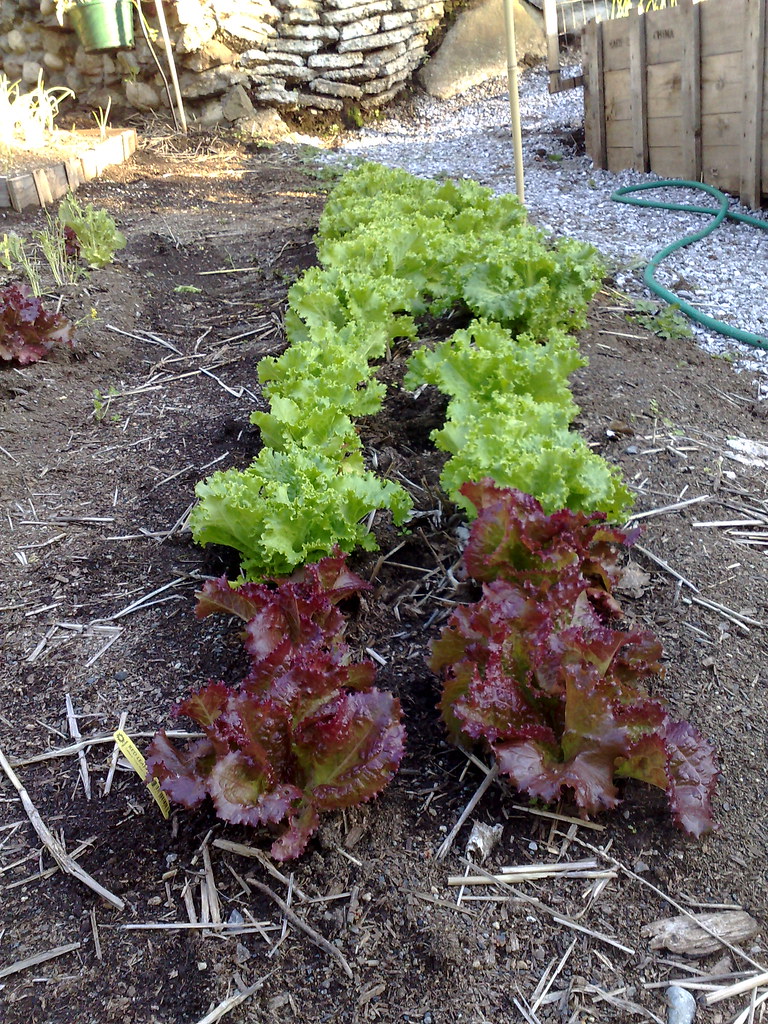
Why Should You Grow Lettuce At All?
Lettuce is a fast growing, highly nutritious salad green that doesn't need a lot of space to grow.
It's also pretty easy to grow. You can grow it in pots, pans, inside or outside and in many different varieties to suit your tastes.
This makes it a perfect choice if you want to grow lettuce all year round.
Nutritional Qualities of Lettuce
As a continuous source of nutrition throughout year, it's hard to beat. According to the Journal of Food Composition & Analysis, lettuce is:
- Low in calories, fat and sodium.
- A good source of fiber, iron, folate, and vitamin C.
- A good source of various other health-beneficial bioactive compounds [1].
Most interestingly though, for those of us who look deeper into our forgotten past, lettuce also has some beneficial health properties that you rarely hear about. 👇
“In vitro and in vivo studies have shown anti-inflammatory, cholesterol-lowering, and anti-diabetic activities attributed to the bioactive compounds in lettuce.
However, nutrient composition and bioactive compounds vary among lettuce types.
Crisphead lettuce, the most popular type of lettuce in the US, is comparatively low in minerals, vitamins, and bioactive compounds.
More nutritious lettuces are leaf type lettuce and romaine with folate content comparable to other rich leafy vegetable sources. Red pigmented lettuce contains higher phenolic compounds than green lettuce.“
It's not surprising that the type of lettuce we “Westerners” consume the most appears to have the least nutritional value!
Health Benefits of Lettuce
Assuming you eat the most nutritious types of lettuce (leafy varieties, romaine varieties and red pigmented varieties), you may experience the following health benefits:
- May Fight Inflammation
- May Aid Weight Loss
- May Promote Brain Health
- May Boost Heart Health
- May Help Fight Cancer
- May Cut Diabetes Risk
- May Promote Vision Health
- May Promote Digestive Health
- May Help Treat Insomnia
- May Enhance Bone Health
- May Boost Immunity
- May Be Good For Pregnancy
- May Improve Muscle Strength And Metabolism
- May Improve Skin And Hair Health
- May Fight Anemia
- May Keep You Hydrated
A more comprehensive explanation of these benefits can be found here.
It makes sense then, that when you plan to grow lettuce all year round that you plan to grow only the most nutritious varieties you can get your hands on.
Different Types of Lettuce
With the prevalence of monocultural agricultural practices; we've been corralled into a place where we seem to label everything in broad categories without really appreciating the many multitudes of varieties of lettuce that is actually available to us.
When you take back that power on your journey to becoming more self-sufficient with food, and you start to grow your own lettuce again (or any food for that matter), you start to appreciate the multitude of varieties available.
It really is a whole new world!
The most common variety you'll have come across is the Iceberg Lettuce and it is probably the least nutritious variety available. No surprise there, right? That's not to say it's bad for you; it's just not as good as others.
Here are some of the more nutritious and beneficial varieties of lettuce you should grow:

Romaine Lettuce

Red Deer Tongue Lettuce

Oak Leaf Lettuce
Of course, these are just three varieties and there are literally hundreds out there.
When it comes to choosing types of lettuce to grow all year round though, I'd only ever opt for heirloom organic seeds from a company like Real Seeds in the UK or Johnny Seeds in the USA. I wouldn't buy any genetically modified seeds but in tough times, I'd for sure buy whatever I could get my hands on regardless.
Heirloom seeds are usually heritage varieties that have been selectively bred through generations for flavour, size, yield or resilience. With heirloom seeds, you can of course embark on that wonderful adventure of saving your own seeds or even creating new varieties of vegetables altogether.
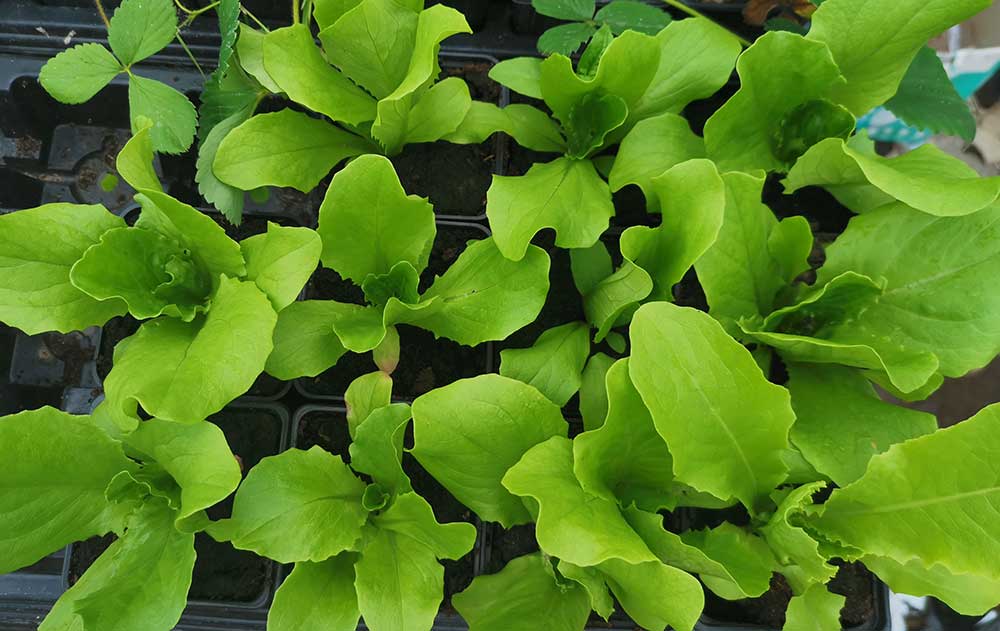
How To Grow Lettuce All Year Round
Lettuce is pretty easy to grow – even if you're a beginner.
They can be planted throughout the year with good success.
In the winter, under the cover of a frost-free and possibly lighted greenhouse (or in the kitchen) and in the spring, summer and autumn straight into the garden.
I do grow mine in a greenhouse though to extend my Autumn and Spring seasons (earlier start in spring and later finish in Autumn).
They prefer well drained, fertile soil or, if you're growing in a pot, some loose potting soil. They need a bright, sunny spot with plenty of room around them to let the air flow freely. This helps prevent dampness and disease.
They are a cooler climate crop and if they get too hot they will start to ‘bolt'. Bolting is when a plant starts to shoot straight upwards and grow flowers ready to ‘go to seed'.
(I get this problem when I leave my lettuce in my greenhouse during the summer and I don't ventilate or water them enough.)
Here's a simple guide to planting lettuce from GrowVeg which goes over all of the basics. It's only 7 minutes long. Take what you can from it and apply what you learn to grow lettuce all year round.

The main thing I want to stress though, is that you can grow lettuce all year round; you just might need to adjust your planting location to suit.
When Should You Plant Lettuce?
Your planting schedule will vary depending on your climate. Here in the UK, you can pretty much plant lettuce all year round by making a few adjustments for the seasons.
We wrote a comprehensive guide to planning a vegetable garden that you could definitely use to help your yields.
After about 10 years of growing my own veg, here's a little lettuce planting table with some observations I've collected through the years that might also help extend your lettuce growing season:
| Planting Season | Where To Plant | Time To Harvest |
|---|---|---|
| Spring | Sunniest Spot of Garden | 6 – 8 Weeks |
| Summer | Shadiest Spot of Garden | 6 – 8 Weeks |
| Autumn | Sunniest Spot of Garden | 6 – 8 Weeks |
| Winter | Under Cover of Greenhouse (or Kitchen) | 10 Weeks |
How Much Space Do You Need To Grow Lettuce All Year Round?
Optimally, a lettuce plant will need about 12 inches between plants to yield the biggest lettuce you can grow.
If you don't have a garden, just plant one lettuce plant per pot and fill your window shelves up!
How To Plant Lettuce
I've always found it better to plant the seeds in trays or modules before planting them out into the garden but you could go straight for the garden.
I choose to go with modules because I have more control over their initial growing stage (watering, temperature) and I can keep an eye on slug damage.
The difficulty with straight to garden planting for me is that I never truly know whether my seedlings have been eaten by something or they just haven't germinated. Growing under the cover of my greenhouse (or in my kitchen) allows me to keep a close eye on conditions as they sprout.
I find, almost without fail, that seeds I plant in my greenhouse in modules almost always germinate whereas outside…I'm just never quite sure!
How long does lettuce take to grow?
Most lettuce usually take about 6 to 8 weeks to grow large enough to harvest in optimal conditions.
Leafy varieties can be harvested sooner (and repeatedly) as they grow back leaves as you cut them. These are often called ‘cut and come again' varieties like the Red Deer Tongue or Oak Leaf shown above.
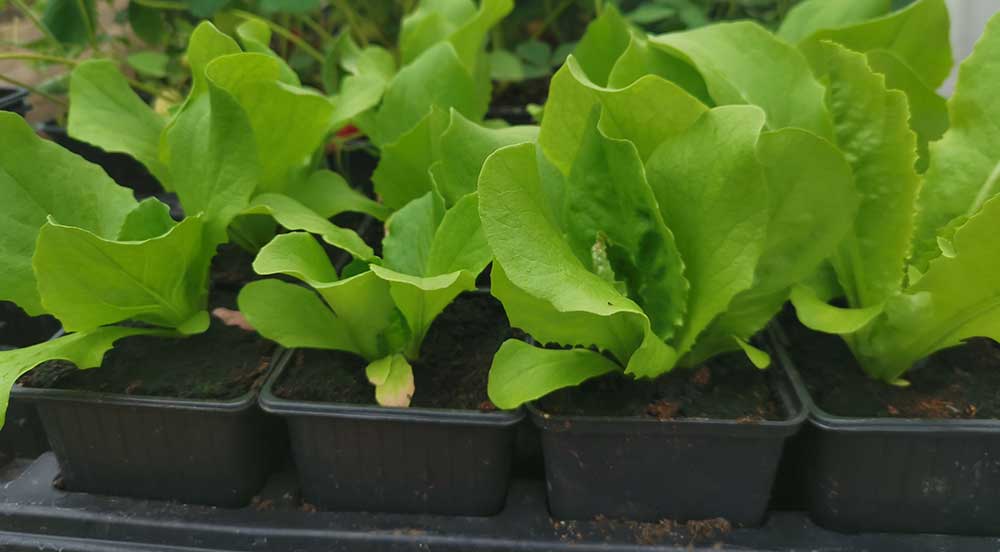
Harvesting Lettuce
Lettuce is one of the easiest vegetables to harvest. There are no hard and fast rules and harvesting really depends on your own tastes and the variety of lettuce you've grown.
In short, when it is big enough to eat, it's ready to harvest!
For the most flavour though, harvest early in the morning, preferably after a crisp, cool night.
For varieties that come to a head, you need to wait until the head is large enough to eat.
For leafy varieties, or ‘cut and come again' varieties, you can start harvesting as soon as the leaves are big enough to eat. You can either cut the whole bunch of leaves off or you can cut a 3rd of the leaves at a time and cut the rest as you need them.
For most leafy varieties, cutting the whole bunch of leaves off usually encourages more growth and you'll generally get 3 bunch cuts from each leafy variety if you do it this way.









Thank you this is so useful for a beginner!
You’re welcome, Susie! I hope it gives you wings.
I am going to start sowing lettuce seed in bi-weekly batches now, and transplant into the Tomato containers as soon as the compost has been replaced, possibly radishes too. We like Iceberg, and I will try the red lettuce too.
Here in the UK it is likely the Tomato growers won’t be planting due to the Energy Crisis, so there may not be much choice of salad foods in the Supermarkets next year.
It’s worth sowing the less common lettuce, Jacqueline because they are the most nutritious.
Iceberg, of all the lettuce, is the one that provides the least nutritional value! Typical, isn’t it…the one they mass produce and raise us on is the one that gives us the least nutrition.