Are you longing for the satisfaction & security of growing your own fresh fruits and vegetables in a self-sufficient garden? Look no further. In this guide, I've curated a list of ten complete self sufficient garden plans for small, medium and large gardens that you can copy and adapt to your own space.

With these plans, you'll have all the ideas you need to create a bountiful garden that will nourish you and your family no matter how crazy the world outside gets or how big your space is.
Join me as I delve into the world of self sufficient gardening and explore the successful layouts that seasoned growers use year after year to create the perfect self sufficient garden plans.

Basic Rules Applicable To All Size Garden Plans
Before I share the garden plans, there are some basic rules that John Seymour, author of ‘The Self Sufficient Gardener‘ says should be applicable to all self sufficient gardens, no matter the size.
I highly recommend John's book if you're looking to start your own self sufficient garden.
In it, he says that rather than think in terms of ‘standard sizes' for self sufficient gardens (because everyone has a different size garden), you should instead have a “basic plan in your head and think of it as coming in three models: small, medium and large.“

All three sizes are conditional on you having worked out that you have:
- The right soil conditions to grow
- Decided what vegetables you are going to grow
- And where you are going to site the garden constructions.
He suggests that you create this plan for a small garden and scale it up as required.
He frames everything at the very basic level in the eyes of the English farm labourer who, for their 28 shillings a week, could not afford to buy a lot of food:
Instead, they grew potatoes on at least half of their gardens in the summer with a long row of runner beans (because they were so productive), then they grew as many brassica plants as they could in the winter (broccoli, brown mustard, Brussels sprouts, cabbage, cauliflower, kale, kohlrabi, rape, rutabaga and turnip).
They didn't bother with much else. If you use this as your starting point (adjusted for your climate) then you can work outward from these basics.
I wrote a complementary planting guide for self sufficient gardens here, which shows you how much space you need to grow enough of a given crop to feed a family of 4.
Use this as your guide.
Now, onto the self sufficient garden plans.
Self Sufficient Garden Plans For Small Gardens


While the humble small garden may seem limiting at first glance, a small garden can be just as abundant and fruitful as a larger plot of land with a bit of ingenuity.
In fact, small gardens or no soil gardens present a unique opportunity to exercise your creativity and resourcefulness in the art of self-sufficient gardening.
In this section, I've gathered a collection of some of the best self sufficient garden plans I could find specifically designed for small gardens.
These plans offer a range of options, from compact raised beds to container gardens, all tailored to make the most of your limited space.
The Cool Weather Container Garden
The following plan provides a cool weather layout using EarthBox containers but they could be substituted for other alternative containers if you can't get EarthBox in your area.
The plan requires:
- 8 EarthBox Original containers measuring 29″ x 11″ x 10″
- 4 EarthBox Root & Veg containers measuring 17″ x 16″ x 10″
- 4 EarthBox Junior containers measuring 23″ x 7.5″ x 9.5″
In this plan, you'll grow:
- Peas
- Cabbages
- Onions
- Carrots
- Beets
- Kale
- Lettuce
- Spinach
This plan will produce all season long and even give you some extra for the winter with the storage potential of the carrots and beets.
The Warm Weather Container Garden
The following plan provides a warm weather layout using EarthBox containers but they could be substituted for other alternative containers if you can't get EarthBox in your area.
The plan requires:
- 8 EarthBox Original containers measuring 29″ x 11″ x 10″
- 4 EarthBox Root & Veg containers measuring 17″ x 16″ x 10″
- 4 EarthBox Junior containers measuring 23″ x 7.5″ x 9.5″
In this plan, you'll grow:
- Tomatoes
- Winter Squash
- Sweet Peppers
- Bush Beans
- Hot Peppers
- Herbs
Less Than A 1/4 Of An Acre
This next plan is inspired by Becky over at Seasonal Homestead who grows a number of gardens in her 1/4 of an acre plot but this particular plan below is for her 16 x 20ft smallest section.
Becky is growing for a family of 6 so the amount of food she needs to grow is quite large.
In this plan, you will grow:
- Sage
- Marigold
- Tomatoes
- Onions
- Sweet Potatoes
- Cabbage
- Okra
- Kale
- Cowpeas

Self Sufficient Garden Plans For Medium Gardens
If you have a larger garden of 1/4 of an acre or more, then you can copy these proven self sufficient garden plans for medium gardens.
Of course, you'll need to adjust to suit the size of your family and the climate you're growing in but hopefully by seeing how others plan for and grow their own food, you'll be able to draw some inspiration from them to create your own self sufficient garden plan.


The Self Sufficient Backyard Plan
This is a wonderful plan for a self sufficient garden on 1/4 acre.
It is based on over 50 years of self sufficient living and makes use of all the best practices for growing more from whatever space you have including keyhole/horseshoe gardens, no dig gardens, perennial vegetables, fruit trees, crop rotation, mulching, vertical gardening and much, much more.
I've tried to enlarge the plan as much as I could but for the full ‘how to' from start to finish, you'll find it all in The Self Sufficient Backyard book (available as hard copy or digital download).
The Small Perennial Food Forest

This plan is focussed on a low-maintenance perennial food forest in a small – medium sized garden.
It used the principles of permaculture to make use of cover, shade, water and zoning and is designed to make growing your own food simple for people with busy lives.
Of course, it may take a few years to arrive at full production but it'll be worth it in the end.
This plan was suggested in Dick & James Strawbridge's “Practical Self Sufficiency For Today” book, which you can buy here from an independent book retailer.
1/2 – 1 Acre Self Sufficient Garden Plan
This plan was designed by DaNelle over at Weed'em and Reap and is most suited to a medium-sized garden of between 1/2 to 1 acre.
In this plan, you'll grow vegetables, herbs, fruit & nut trees and raise animals like chickens, rabbits, goats and sheep.
There's even room for a children's play area!
The ‘Food From The Garden' Medium Sized Garden Plan

This plan was designed for the average English garden back in the 50's.
Inherent to the old mining villages of the times, this plan gives the reader an idea of how to layout a self sufficient garden plan, how to rotate crops at the correct time and even what to plant when.
The garden layout consists of:
- A greenhouse
- A coldframe
- Two composting areas (for rotation)
- Various beds and growing spaces for different types of food
Grown in this plan is:
- Potatoes
- Rhubarb
- Spring cabbage
- Globe artichockes
- French beans
- Tomatoes
- Cucumbers
- Melons
- Celery
- Apples
- Raspberries
- Other soft fruits (strawberries, blueberries, blackberries)
Self Sufficient Garden Plans For Large Gardens

Not many ordinary folk tend to have ‘large gardens' these days. That is to say, really large gardens of over 1 acre.
Nevertheless, if we listen to the wise words of John Seymour in his self sufficiency book, a self sufficient garden follows a basic model. It just comes in 3 different sizes: small, medium and large.
Therefore what I show you in a large garden plan can be applied to a small garden on a smaller scale but if you do happen to have a small homestead or over an acre of growing space then you'll find these plans useful.
2 – 3 Acre Self Sufficient Garden Plan
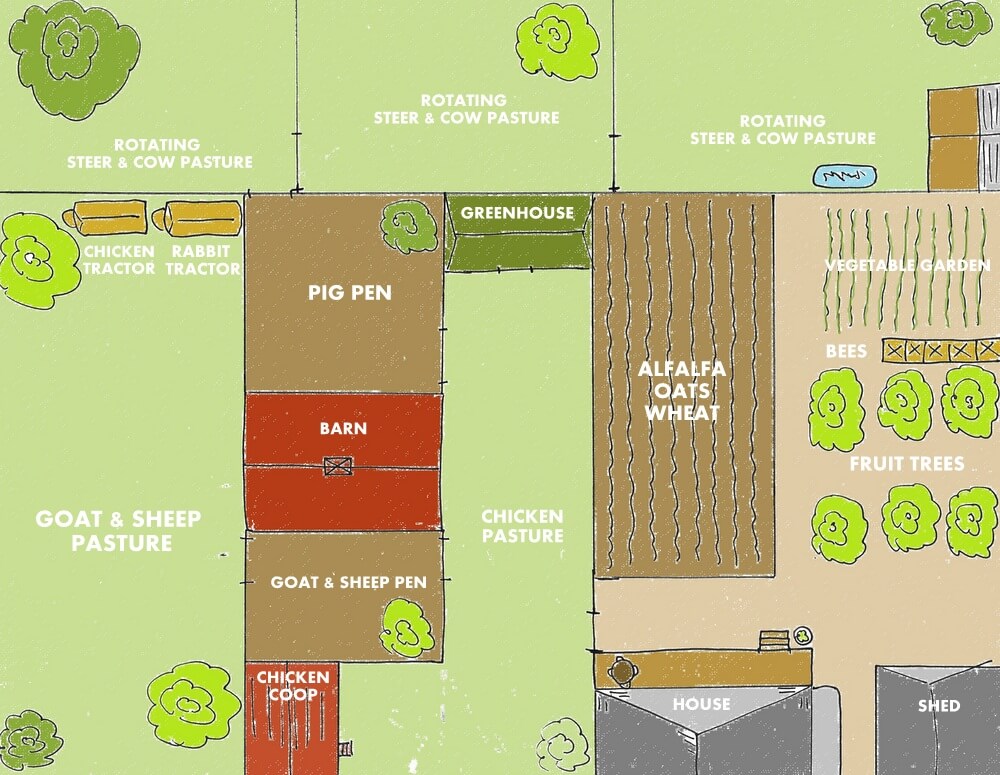
This is another plan drawn by DaNelle over at Weed'em and Reap and tends to focus on livestock rather than vegetables.
I suppose when you have the space, you can put a greater emphasis on rearing good quality natural meat and, in this case, some grains too.
This plan focuses on rearing:
- Goats & Sheep
- Chickens
- Rabbits
- Pigs
- Cows
And growing:
- Grains (Alfalfa, Oats, Wheat)
- Fruit Trees
- Vegetable Garden
And keeping:
- Bees
The Zuyddyk Homestead Garden

This is a large homestead-style plan designed by the good folks over The Old Farmer's Almanac.
The full planting list and planting schedule is available from the website and contains approximately 40 different types of fruit and vegetables you can grow and a comprehensive planting schedule showing you clearly when to sow indoors or outdoors and when to harvest.
The Old Farmer's Almanac also offers a free trial of their very own garden design planner so that you can design your own self sufficient gardens in a similar style to that of the plan shown above.
Final Thoughts: Size Is Not A Limiting Factor When Designing Your Self Sufficient Garden Plans
Through the process of researching this guide, I've come to appreciate that garden size should not be a limiting factor in your quest for self sufficiency.
In fact, in almost all the resources I've linked to and learnt from during the writing of this piece, one theme sticks out in every case: don't take on more than you can reasonably handle.
One of the most common reasons people seeking self sufficiency give up is because they try and do too much in one go, all at once, without much (or any) prior experience. They want to grow all of their own food, generate all of their own power, make their own medicines etc. before they're ready.
This almost always tends to lead to failure and a sense of being overwhelmed.
Instead, you need to build it up bit by bit, bed by bed, tree by tree, plant by plant, season by season.
In this context, the small garden is actually the best way to start practicing becoming more self sufficient because you can do what you can with what you've got and build on those foundations as you learn.
If you succeed in reducing your reliance on supermarkets even for just one crop; you have achieved something important; something empowering, something great.
And in so doing, you have set yourself up for the addiction that comes with growing your own food and the life-affirming, healing journey it offers and no doubt the motivation to keep going, to keep getting better and better at it.
You've taken your first step towards self sufficiency.
If you'd like to join others on the same journey and learn as you go, sign up to the bournebright self sufficiency community and introduce yourself.
I hope I'll see you there.
Beat The Reset
If you enjoyed this guide, subscribe to my newsletter to receive more content like this, lots of positive news stories and some practical solutions to help you beat the reset.