
Learn how to make elderberry cough syrup the original way, like your ancestors did, and help support your family's immune system against coughs, colds and flus this winter.

Have you ever wondered how your ancestors managed to get by without frequent visits to pharmacies and Drs?
Well, before conventional medicine became the gigantic (monstrous?) industry it is today, indigenous tribes or ‘original peoples' as I like to say, used the medicinal powers of herbs to manage symptoms of illness.
Even today, in the few places yet untouched by the hands of ‘progress,' you find shamans, priests, herbalists and other practitioners working closely with nature to heal and restore.
The Elder Tree (Sambucus nigra) is one such herb, called ‘the medicine chest of the country people' by Ettmueller and John Evelyn, a 17th Century Founding Fellow of the Royal Society and English landowner, gardener, courtier and minor government official wrote, in his diary:

“If the medicinal properties of its leaves, bark and berries were fully known, I cannot tell what our countrymen could ail for which he might not fetch a remedy from every hedge, either for sickness, or wounds. [] an extract composed of the berries greatly assists longevity. Indeed, this is a catholicum against all infirmities whatever.”
John Evelyn, Founding Fellow of the Royal Society
We wrote a guide about using Elderflowers to make elderflower cordial earlier in the year, a testament to how beneficial this herb is to health & wellbeing at all times of the year.
But in this guide, we're going to focus on making elderberry cough syrup from the berries, only available for a short window at the end of summer; from August to Mid-September here in the UK.
Why Make Elderberry Cough Syrup?
The world has changed. 2020 marked that moment in time where personal responsibility made a comeback; and that trend is not going to change.
It's therefore incumbent on anyone looking to protect their family in the years ahead, whether from environmental disasters, supply-chain disruption, economic events or anything else to do all that they can to learn how to be more self sufficient and take care of themselves as far as possible.
This is especially true when it comes to your health.
Elderberry cough syrup is revered throughout history as a remedy against colds and flus and the Elder is abundant across most of the ‘developed world', therefore it makes sense to learn to make use of this natural resource by learning to make elderberry cough syrup on your own.
Health Benefits of Elderberry
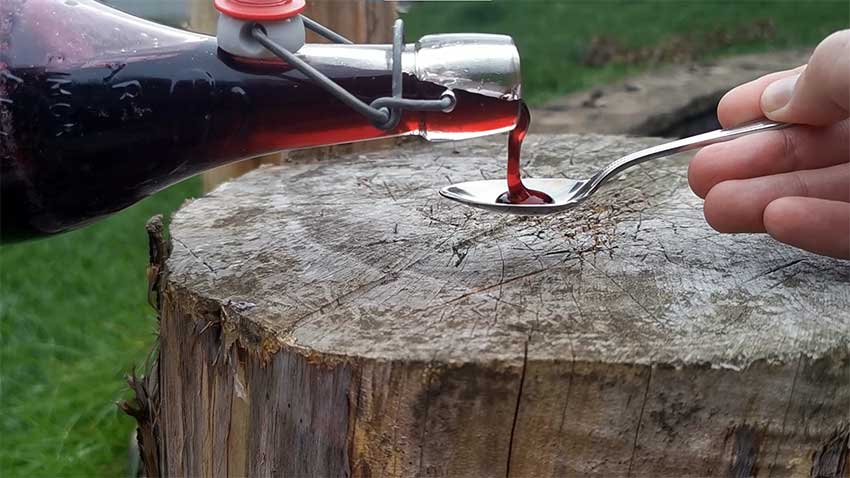
In folklore, as recorded by many authors including Nicholas Culpeper, Sir Thomas Browne, Lady Northcote, Dr Martin Blockwich, Pliny the Elder and Boerhaave all convey the medicinal properties of the Elder.
Some of the purported health benefits include:
- Protect blood vessel walls against oxidative stress, preventing vascular disease
- Reduce harmful cholesterol and prevent atherosclerosis
- Increase resilience to stress
- Antimicrobial and decongestant
- Beneficial at the onset of colds, fevers and flu
- Activate immune response by increasing cytokine production and prevent damage caused by free radicals
- Antiviral action, inhibiting colds and influenza A and B
- Collagen-stabilising action, useful for varicose veins, haemorrhoids, sprains and arthritis
Ingredients
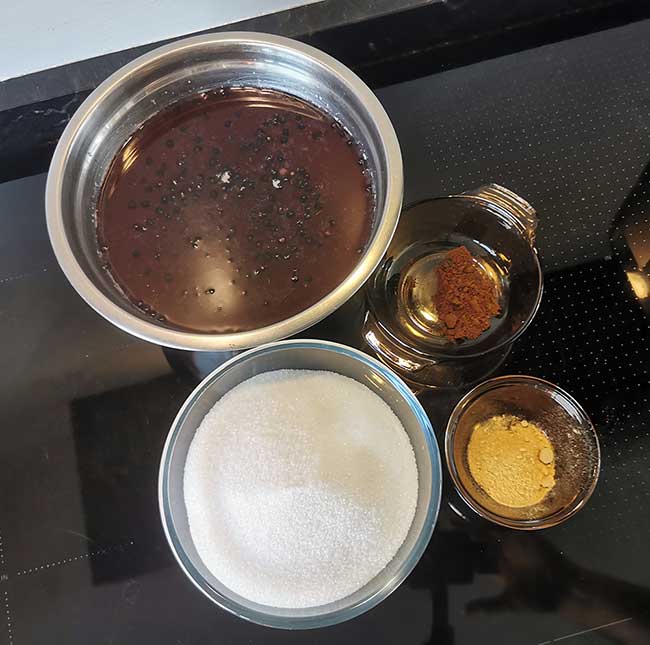
- 50g of fresh elderberries (without stalks/stems)
- 550ml of spring water
- 200g of white sugar
- 1 tsp of ground ginger
- 1/2 tsp of ground cloves
Equipment
- Large bowl to fork your elderberries into
- Large pan capable of holding 5 litres of water
- Pouring funnel
- Muslin cloth or 2ply kitchen towel for straining
- Measuring scales
- Measuring jug
- Small jars to pour the syrup into
How To Make Elderberry Cough Syrup: Step-by-Step Instructions
If you're planning to make elderberry cough syrup from wild herbs you pick yourself, you'll need to pick the berries in Autumn, between August – Mid September, as this is the only time you'll find them on the tree.
How To Identify An Elder Tree
It's important before you go picking wild herbs that you are 100% confident you're harvesting the correct tree.
Here are some checks you can do to make sure you are harvesting the right Elder tree (Sambucus nigra).
Step 1: Look at the Leaves

- Elder tree leaves are opposite, meaning they grow in pairs directly across from each other on the stem.
- Each leaf is composed of 5 to 7 leaflets arranged in a feather-like pattern.
- The leaflets are serrated along the edges, which means they have small, jagged teeth.
Step 2: Examine the Bark

- Younger elder trees have smooth, grayish-brown bark with small raised bumps.
- As the tree matures, the bark becomes rougher and more textured with deep furrows.
Step 3: Observe the Flowers
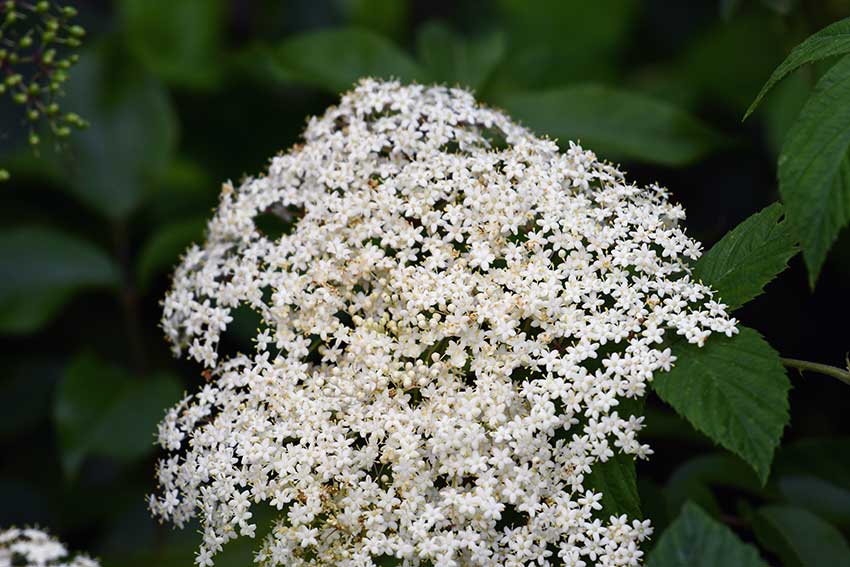
- Elder trees produce clusters of small, creamy-white flowers in late spring to early summer.
- These flower clusters are umbrella-shaped and have a pleasant, sweet scent.
Step 4: Check for Berries
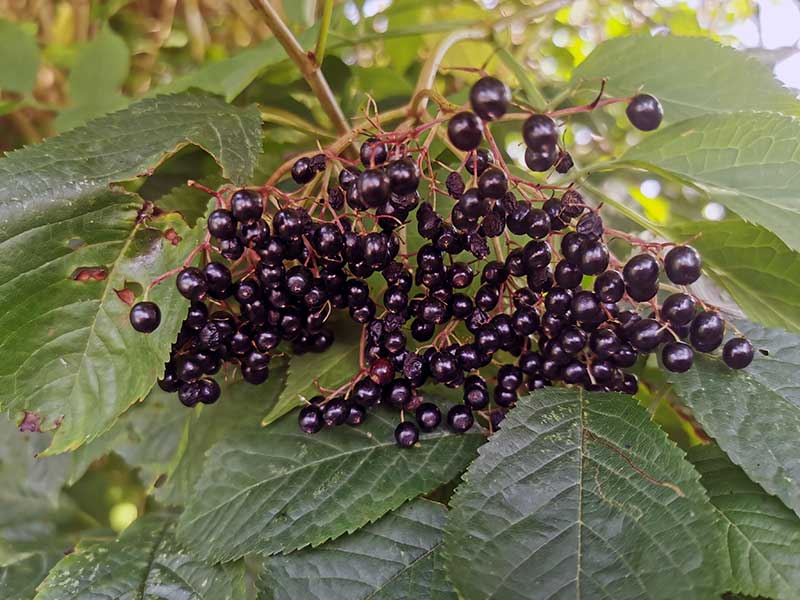
- In late summer to early autumn, elder trees bear clusters of small, dark purple to black berries.
- These berries are typically round and arranged in clusters similar to the flowers.
Step 5: Note the Size and Shape
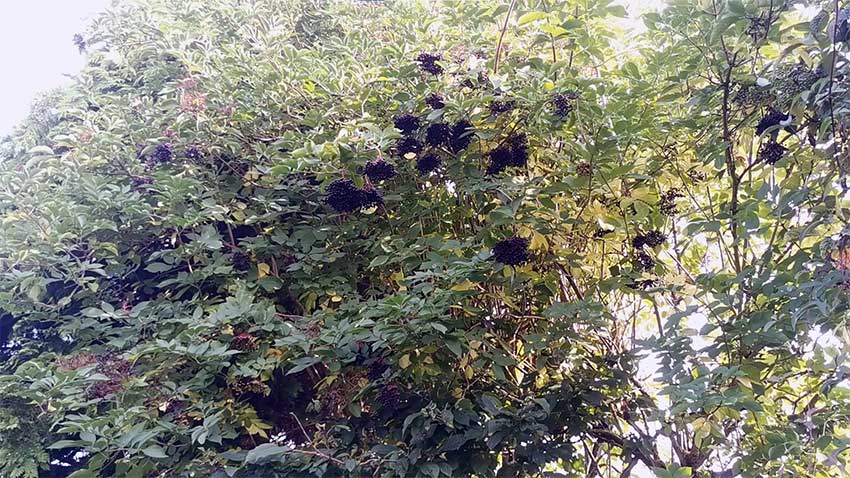
- Elder trees are typically medium-sized deciduous trees that can grow to be 10 to 30 feet (3 to 9 meters) tall.
- They have a bushy, somewhat rounded shape with many branches.
Step 6: Smell the Leaves
- Rub a few leaves between your fingers and smell them. Elder leaves have a distinct pungent, slightly sweet aroma.
Step 7: Be Cautious
- While elderberries are used in various culinary and medicinal applications, some parts of the elder tree, such as the bark and leaves, can be toxic if consumed. Stick to using the berries for consumption.
Harvesting The Elderberries
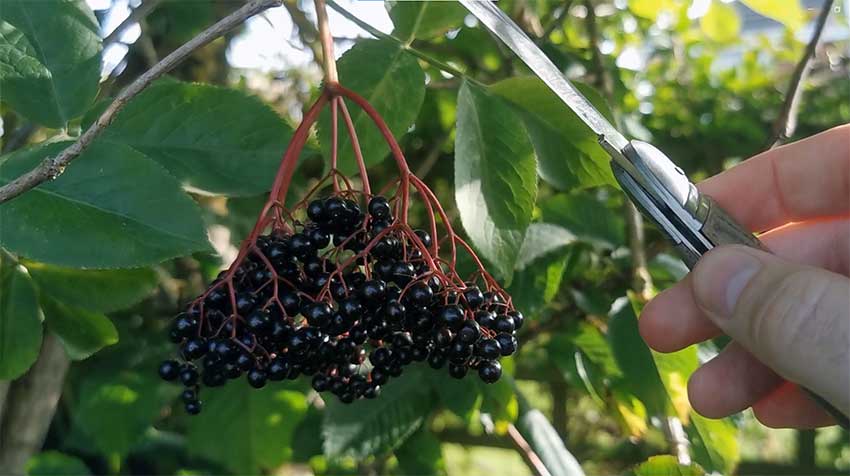
- Before you harvest anything, you need to be 100% certain you have identified the correct tree/herb (see steps above).
- Once you've found a tree, be mindful and respectful of the tree and never take more than 20% of the available berries. You can usually find Elder trees in hedgerows or on wild, abandoned land with some greenery.
- Harvest the berries by cutting a full umbel of berries from the tree at the stem. This will make it easier to carry and bag up.
- Only harvest berries that look plump and ripe. Avoid dried or withered berries. Sometimes different parts of the tree ripen at slightly different times.
- Repeat until you have enough for your recipe.
Preparing the Elderberry Syrup
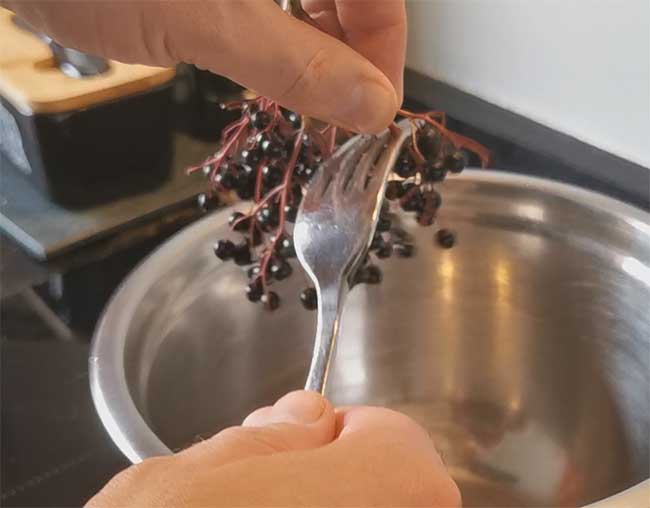
- Use a fork to agitate the berries from the stem and into your bowl.
- Make sure you don't accidentally drop any stem into the bowl as it can be toxic if consumed.
- Pour 50g of berries into your pan and add 550ml of spring water and leave to soak overnight.
- Add the ground ginger and cloves.
- Cover and bring the pan to a boil slowly before turning down the heat to let simmer for a further 20 minutes.
- Strain the liquid (aka ‘decoction') through a muslin cloth or 2ply kitchen towel to seperate the liquid from any remaining pulp.
- Allow the strained decoction to cool to room temperature and strain again.
- Pour the cooled decoction into a pan and slowly heat to 140-160 F. Maintain this heat until the volume of liquid reduces to 125ml.
- Add 200gm of sugar and stir over a gentle heat until the sugar is completely dissolved.
- Remove from heat, cover and let cool.
- Pour into small storage bottles.
Substituting Sugar for Honey
You can use honey or maple syrup as a substitute for the sugar. They both perform the same function as sugar, acting as both preservative & sweetener.
The conversion of maple syrup/honey vs white refined sugar in recipes can vary depending on the recipe, but typically 200g of white sugar can be replaced with 150g of maple syrup.
Preserving the Syrup

This particular recipe does not require any special preservation techniques as it will store in a cool pantry.
The volume of sugar in the recipe acts as a preservative, being too high an amount for bacteria to form.
The Elderberry Cough Syrup should have a shelf life of approximately 1 year from the time you bottle it up but as with all such things, always smell and look before you consume.
If something looks or smells off, it's probably off.
Dosage and Usage
- The recommended dosage for this recipe of elderberry cough syrup is 1 teaspoon for children and 2 teaspoons for adults once per day at the onset of symptoms until symptoms are gone.
Important: I am not a medical practitioner so please consult your own healthcare provider for advice suitable for your own context.
Additional Tips and Variations To The Recipe
- You can substitute the sugar for honey or maple syrup. Best practice seems to indicate that you should swap 200g of white sugar for 150ml of honey or 100ml of maple syrup. I've not tried either but if you have, please leave a comment and I'll add it into the article with credits.
- You can adjust the flavour of the syrup by increasing or decreasing the amount of ginger/cloves you add or even add your own beneficial herbs to the syrup.
- This particular recipe for elderberry syrup was designed as a cough syrup, to be used at the onset of symptoms or once a week as a preventative measure but elderberries have been used as a culinary flavouring for centuries and are most often used to make jams or preserves, wines or as a glazing syrup for sweet desserts.








Thanks for this information. I am happy thinking of like-minded folk trying to help others become healthier using natural ingredients. I’m going to give this recipe a try using honey or maple syrup. Mmmmm, should be good tasting.
Hi Jo, thanks for commenting.
Please come back and post a comment about your honey and maple syrup variations. I’d love to hear more about how that goes and perhaps add in any findings to the main guide.
👍
Thanks!