I'm actually quite amazed by how many people have asked me about self sufficiency in the bible over the last few years and want to know what the bible says about it. I was asked so many times, in fact, that I had no choice but to spend a few weeks reading the bible to find out.
Self sufficiency in the bible is referenced at least 80 times in 80 verses according to OpenBible and the vast majority (if not all) of the references teach that human sufficiency is not rooted in oneself but is derived from God.
The gist of the verses appears to be that all abilities, strengths, and gifts come from Him, not yourself, and that one should not ‘seek' self sufficiency because it displaces God.
But; there is a twist…
Initially, I was shocked by this because as a man dedicated to becoming more self sufficient in my life, all I want to do is protect my family and be a careful and respectful steward of the land I temporarily walk upon.
Virtues, I thought, any benign God would encourage.
The revelation that my self sufficient way of life seemed atithetical to the Christian faith led me down a rabbit hole that might just blow your mind.
What Are The 80 Verses About Self Sufficiency In The Bible?
There are atleast 80 verses in the bible that can be thought to reference the idea of self sufficiency in some way according to OpenBible.
I won't copy them all here word for word but I'll share the top 5 bible verses about self sufficiency that seem most relevant and post a list of the remaining verses below for your own research.
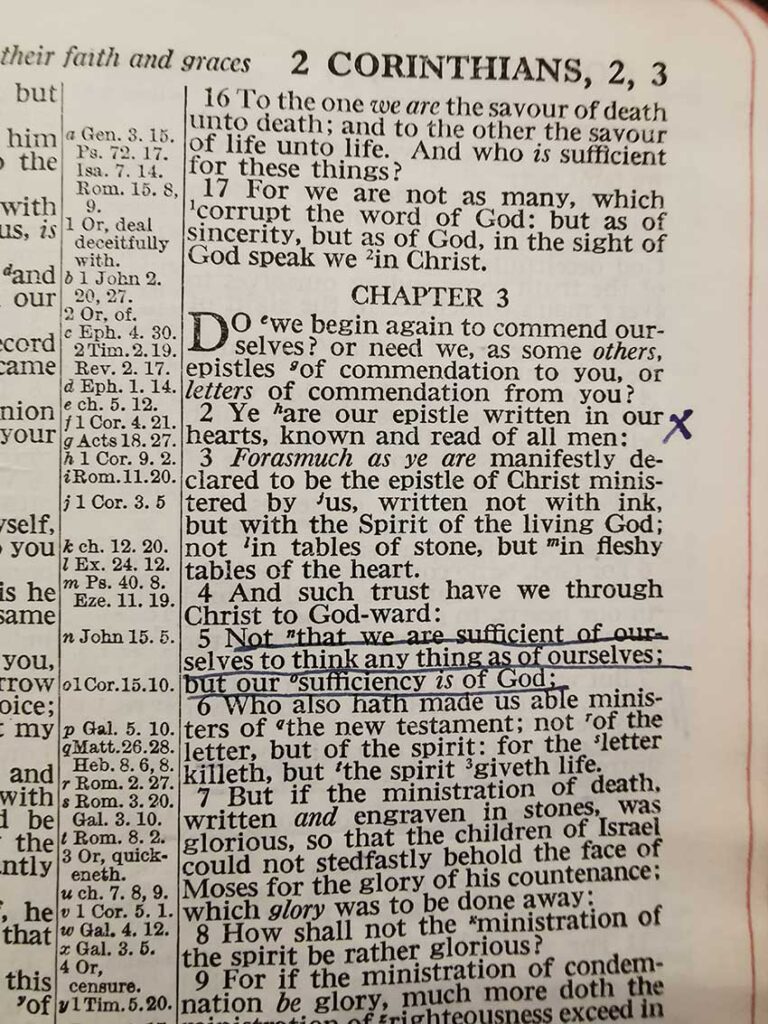
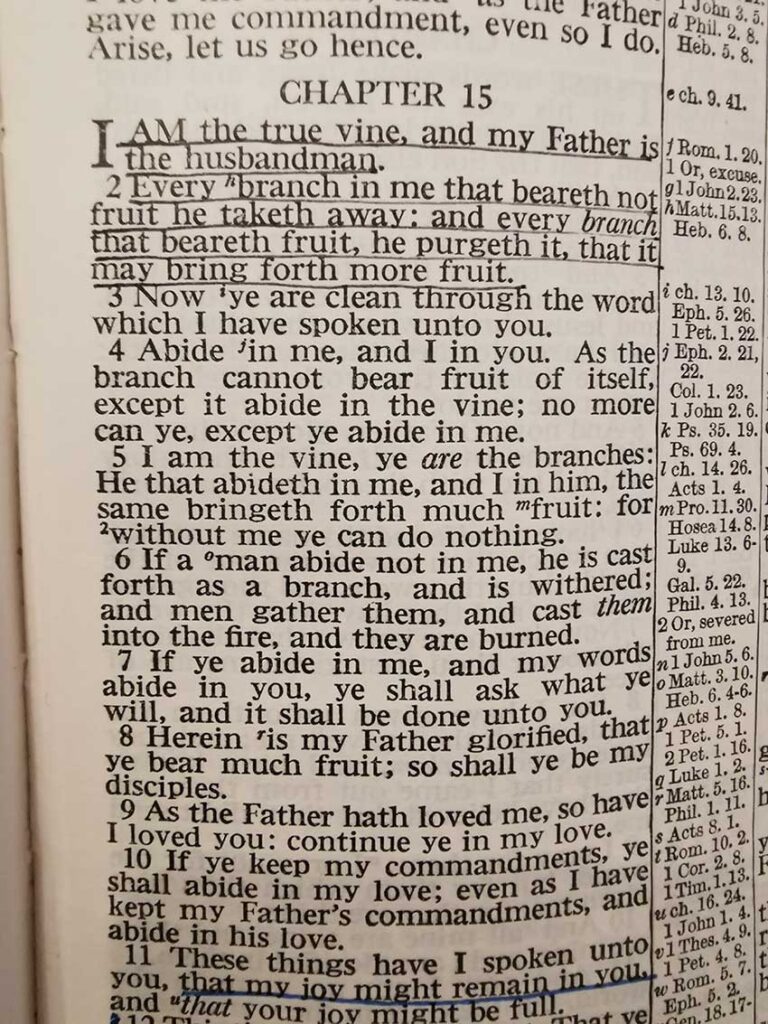
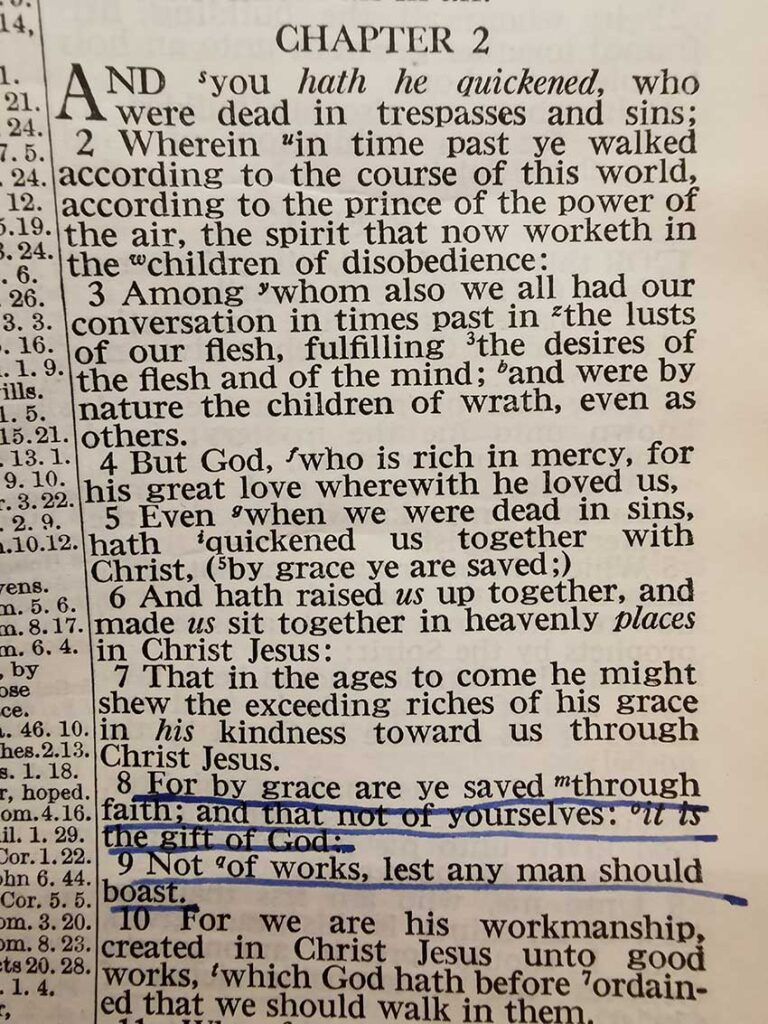
I'll also add in an image of the actual verse from my 120 yr old King James Bible to cover any differences in translation so you have at least a couple of reference points.
2 Corinthians 3:5 ESV
Not that we are sufficient in ourselves to claim anything as coming from us, but our sufficiency is from God,
John 15:5 ESV
I am the vine; you are the branches. Whoever abides in me and I in him, he it is that bears much fruit, for apart from me you can do nothing.
2 Corinthians 12:9 ESV
But he said to me, “My grace is sufficient for you, for my power is made perfect in weakness.” Therefore I will boast all the more gladly of my weaknesses, so that the power of Christ may rest upon me.

Luke 12:16-21 ESV
And he told them a parable, saying, “The land of a rich man produced plentifully, and he thought to himself, ‘What shall I do, for I have nowhere to store my crops?’ And he said, ‘I will do this: I will tear down my barns and build larger ones, and there I will store all my grain and my goods. And I will say to my soul, “Soul, you have ample goods laid up for many years; relax, eat, drink, be merry.”’ But God said to him, ‘Fool! This night your soul is required of you, and the things you have prepared, whose will they be?’ …

Ephesians 2:8 ESV
For by grace you have been saved through faith. And this is not your own doing; it is the gift of God,
List of Other Bible Verses About Self Sufficiency
- 2 Corinthians 3:5 ESV
- John 15:5 ESV
- 2 Corinthians 12:9 ESV
- Luke 12:16-21 ESV
- Ephesians 2:8 ESV
- Isaiah 50:10-11 ESV
- 1 Peter 4:10 ESV
- Romans 12:3 ESV
- John 6:63 ESV
- Luke 9:23-24 ESV
- Matthew 6:34 ESV
- Proverbs 16:9 ESV
- 2 Peter 1:3-4 ESV
- 1 Corinthians 15:10 ESV
- John 5:26 ESV
- Hebrews 11:6 ESV
- 2 Timothy 3:17 ESV
- Philippians 4:13 ESV
- Acts 17:25 ESV
- Acts 17:10-11 ESV
- John 3:1-36 ESV
- 2 Timothy 3:16-17 ESV
- 2 Corinthians 4:7 ESV
- Romans 1:1-32 ESV
- John 1:3 ESV
- 1 John 2:1-29 ESV
- James 1:17 ESV
- Hebrews 4:12 ESV
- 2 Timothy 2:2 ESV
- 2 Thessalonians 1:1-12 ESV
- 2 Corinthians 12:9-10 ESV
- Acts 17:24-28 ESV
- Acts 4:12 ESV
- John 3:16 ESV
- Luke 18:9-14 ESV
- Obadiah 1:3-4 ESV
- Proverbs 3:6 ESV
- Ruth 1:1-22 ESV
- Deuteronomy 4:2 ESV
- Exodus 3:14 ESV
- Revelation 18:7 ESV
- 2 Peter 3:16 ESV
- 1 Peter 2:1 ESV
- James 1:1-27 ESV
- Hebrews 9:14 ESV
- Hebrews 7:25 ESV
- 2 Timothy 4:1-5 ESV
- 2 Timothy 1:12 ESV
- Ephesians 3:20 ESV
- Galatians 6:2 ESV
- Acts 17:11 ESV
- John 17:17 ESV
- John 1:4 ESV
- Matthew 19:26 ESV
- Daniel 6:26 ESV
- Isaiah 40:28 ESV
- Psalm 102:25-27 ESV
- Deuteronomy 8:2-3 ESV
- Revelation 18:1-24 ESV
- Revelation 1:1 ESV
- 2 Timothy 3:15 ESV
- 1 Timothy 6:16 ESV
- 1 Timothy 5:24 ESV
- Colossians 1:15-20 ESV
- 2 Corinthians 5:7 ESV
- 2 Corinthians 2:1-17 ESV
- Romans 10:17 ESV
- Acts 17:24 ESV
- Acts 17:23-25 ESV
- John 1:1 ESV
- Malachi 3:6 ESV
- Proverbs 26:16 ESV
- Proverbs 13:10 ESV
- Psalm 139:13-14 ESV
- Psalm 90:1-2 ESV
- Psalm 10:4 ESV
- Job 41:34 ESV
- Esther 7:1-10 ESV
- Deuteronomy 6:6 ESV
- Genesis 21:33 ESV
After reading the top 5 verses above you'll notice that the theme running through them is one of dependence on God and not self sufficiency. But there's something interesting about it.
What's Interesting About Self Sufficiency In The Bible
What's interesting about the top 5 verses about self sufficiency in the bible is that they all appear in the New Testament. These verses seem to strongly admonish the idea of self sufficiency.
Now, before I take you down this next rabbit hole, it's important to say here that when it comes to the Bible, Gods and Religions, I'm somewhat of an open-minded soul, fully cognizant of the fact that many cultures & civilisations throughout history (way before the year 1 AD) have held different beliefs and that all beliefs must have some truth in them somewhere.
I'm also aware that all things are open to interpretation and rather than look for (or fight over) the differences between Gods and Religions, I tend to look for the similarities.
I look for common threads between ideas, civilisations and timelines because if there is one god or universal consciousness, then surely he/it would have left his signature in all things? Like a maker's mark?
Thus, when I discovered that these verses were all found in the New Testament, I naturally wanted to know what the Old Testament said about self sufficiency?
Seeking help; I put the question out to the more knowledgeable folks on twitter.
What Do Real People Think About Self Sufficiency In The Bible?
Over 30 people responded to the question I posed and the answers varied greatly from, at one end of the scale, “there's no difference, they're both made up” to:
“Proverbs 6:6-8 (NIV): “Go to the ant, you sluggard; consider its ways and be wise! It has no commander, no overseer or ruler, yet it stores its provisions in summer and gathers its food at harvest.” This passage encourages industriousness and the importance of preparing for the future, as exemplified by the ant's diligence in gathering food.
Proverbs 21:20 (NIV): “The wise store up choice food and olive oil, but fools gulp theirs down.” This verse suggests that wisdom involves planning and storing resources for the future rather than reckless consumption.”
You'll notice that both of these Proverbs seem to extoll the virtues of self sufficiency or, at the very least some form of preparedness, in accord with the season, and come from the Old Testament.
I was intrigued; was the old testament pro self-sufficiency and the new testament against it? If so, why? Who wrote them? When? And for what purpose?
What Is The Difference Between The New Testament and The Old Testament
The main difference between the two ‘books', according to Compelling Truth, is the time period. The Old Testament is said to chronicle the work of God from the time of Moses until around 400BC.
The New Testament is said to have been written between AD 50 and AD 150 and is mostly concerned with the fulfilment of prophecy through the life and work of Jesus as told by the disciples who followed him.
Bible Info claims that 40 different authors wrote the Bible over a period of 1,500 years.
But the more I dug into this, the more I learned that the books of the bible evolved over time, with some being removed to “fit the needs of the church” as time went by. Worrying, considering how disingenuous the ‘church' appears to be right now – and I'm referring specifically to the western variety of the Catholic Church.
For example, the KJV version of the bible has 66 books, The Roman Catholic Bible 73 books and the Ethiopian Orthodox Church includes 81 total books in its Bible, having refused to remove certain books from its canon like Enoch and Jubilees.
I started to become more interested in the books that were removed than the books that remained but chasing that rabbit hole will have to wait for a follow-up article. For now, I've bookmarked the books of the Ethiopian Orthodox Church as a future research project.
Trying to get back on track with my original search about self sufficiency in the bible, I began to form a picture in my mind that the evolution of the bible in different canons was largely the result of vested interests; where books that challenged the prevailing views of the church at the time were removed to further the church's aims.
Ironic, considering the christian belief that the persecution of jesus was a direct result of his doing just this – challenging an established order.
Forming My Own Conclusions About Self Sufficiency In The Bible
The discovery that the bible appears to be an impermanent collection of books that changes (changed) over time as a result of political will, makes it hard for me to relinquish my intuition to its direction, especially anything that seems to teach you not to be more self sufficient, not to harvest what you sow and not to store for tough times.
Adhering to those directions seems to fit the political will and desire to keep you dependent and helpless.
However, I also recognise in almost all of the verses I read that there is an innate conectedness about it all; and that hoarding for the sake of hoarding, forfeiting hard work and loving yourself more than loving God leads nowhere good.
What I know for sure though, without doubt, is that my soul is unedited and unabridged and comes direct from source.
And that is something I trust far more than anything else.
Because whatever it is that makes me feel that way, I believe that comes direct from God.