Self sufficiency is having the ability, skill and grit to determine your own future by the acts of your own hand. It is the inherent human desire to do what you can with what you've got to become more independent and resilient in your life.

Like Daniel Freeman for instance; who, in 1863, claimed 160 acres of barren land virtually for free and became the first ‘homesteader' to file a claim under the now repealed Homestead Act (1862).
The act granted Mr Freeman, as head of his family, 160 acres of land as long as he had never borne arms against the United States and could show that he had developed the land he'd claimed in his previous 5 years of ‘ownership'.
Of some 500 million acres dispersed by the General Land Office between 1862 and 1904, only 80 million acres went to homesteaders like Daniel Freeman.
The rest allegedly ended up in the hands of speculators and the already wealthy.
Nevertheless, that's still 80 million acres of land in the hands of the most gritty and hardworking homesteaders who really had to learn first-hand what self sufficiency was all about.
Many of those that tried didn't make it through the first 5 years because of the blizzards, drought, disease, plagues of locusts, and loneliness on the open prairies.
Those who did survive, however, give us a brief glimpse into what self sufficiency really is and what it takes. Or, at least, what it was and what it took.
In this short essay, we take a deeper dive into self sufficiency and try to answer that trending question: what is self sufficiency? And why is it so important now.
What Is Self Sufficiency? Then and Now
Even with the vast infrastructure advances between 1863 and now, the fundamental ethos of self sufficiency remains: to provide for one's security and sustenance by one's own hands with as little external inputs as possible.
The fact that this deep-seated desire remains at all, despite the societal changes around us that make the daily chores of life ‘easier' to do, suggests that there is something inherent within each of us that yearns for some level of independence; to be the master of our own ship
To know that what is yours is yours by your own hands is a powerful and meaningful state of being to hold that lends itself wholly to the psychological notion of fulfilment. Of purpose. Of a reason for being.
And what man or woman, placed here in this realm, could say honestly that their life would be better without free agency to do as one wills and carve one's own path?
Thus, self sufficiency is not just an idea or lifestyle, it is the inalienable condition of life in this experience.
How self sufficient you choose to be; well, that's something else entirely.
Is Self Sufficiency Still Relevant Today? In The 2020s
Self sufficiency has never been more relevant in 2023. We need only cast our minds back a mere 2 years to when the world was shut down overnight; suspending supply chains globally.
I remember clearly how here in the UK we saw supermarkets ration food, how retail stores couldn't get hold of goods and most annoyingly, how there were even mountain bike shortages!
The systemic interlinking supply chains and interdependence (or could you call it dependence) that caused the bottleneck in supply are still in place today; and it seems ever more likely that such an event will occur again in the future.
Given that self sufficiency covers many aspects of independent living like growing and preserving your own food, generating your own power, making money from your homestead or land and looking after your own health, self sufficiency is key to surviving such systemic shocks as witnessed in 2020.
Thus, it is not only relevant, it is absolutely essential.
The History of Self Sufficiency

The concept of self-sufficiency has its roots in the early agrarian societies, notably with the Sumerians, Akkadians, and Babylonians who thrived around 3500 BCE. These civilizations achieved self-sufficiency through the practice of irrigation and the cultivation of crops within their geographic domains, effectively sustaining themselves.
In reality though, self sufficiency likely goes back as far as humans have walked this place. You could argue that any civilisation, or even any tribe, village or family that was able to survive without trading beyond their geographic boundary was self sufficient.
Without the means of rapid transport that we enjoy today, what you ate was largely reliant on what you could grow or what you could hunt or forage within your area. This is self sufficiency.
How Self Sufficiency Changed Throughout History
As civilizations, societies, tribes, and families evolved, they not only mastered the art of self-sufficiency in providing for their basic needs but also acquired the knowledge of generating surpluses.
It was these surpluses that transformed into tradable commodities, expanding the scope of trade beyond their immediate geographic boundaries.
As society continued to develop with technology, cooperation and trade to where we are today, individuals have become increasingly more secular and began to look upon themselves as their own kingdoms.
Where self sufficiency was once the ability for a civilisation to feed and defend itself, it has now become the ability for the individual to feed and defend themselves.
The irony however, is that whilst the individual may well be able to grow enough food to feed his family on land that he owns or has access to, most of the tools, transport and storage he uses to do so comes from beyond the boundaries of his own kingdom.
It begs the question: is anyone really ever self sufficient at all?
The Many Paths To Self Sufficiency

Self sufficiency is a goal with many paths. Although it is an all-encompassing philosophy that can be applied to almost every aspect of your life, there are many ways to get there.
There is no right or wrong way to arrive and there is an infinite number of variables that affect what self sufficiency means for you.
For example, do you want to buy less food at the stores? Do you want to pay less for your electricity? Do you want to earn some money from your own land? etc.
In my case, I'm striving to become more self sufficient in food, in energy, in income and in health so that I no longer have to rely on the state (or the stability of the state) for the basic necessities of life.
But that by no means is an exhaustive list. You could also be striving for self sufficiency in:
- Education
- Childcare
- Maintenance
- DIY
- Mechanical
- Financial Independence
- Self defense
- Community
- Travel
Or more.
But here's the thing; whichever facet or skill you learn and master on your journey towards self sufficiency, it contributes to the whole.
You can never be ‘less self sufficient' than when you started – once you start.
Why Becoming More Self Sufficient Is The Most Important Thing You Can Do For Your Family In The 2020s
Becoming more self sufficient is the most important thing you can do for your family in the 2020s because we are in an unfortunate (or fortunate) moment in human history – depending on how you look at it.
Global Instability And Uncertainty
On the one hand, we have global instability and uncertainty alongside a growing distrust of incumbent governments and a history of wasteful, wasteful mismanagement of the public purse.
Even with my most rational head on, these events seem only likely to lead to the widespread collapse of party politics in the western world and subsequent civil unrest as more corruption and mismanagement of public services, finances and healthcare emerge into the public domain.
You could say it is a recipe for disaster.
Huge Opportunity For Positive Change
On the other hand, you have this unique opportunity to hold public officials to account and really hold them to the fire over the bad policy decisions they made in ‘your best interest' over the last 3 years.
Either one of these scenarios could play out or, more likely, a combination of both.
We already saw how quickly global trade can come to a standstill back in 2020 and how pernicious such measures can be to an economy all the way down the line to the small mom & pop store you buy your groceries from.
The Sad Reality
The sad reality is that we have become so dependent on these inter-dependant global supply lines that it is actually inevitable that at some point in time, a real supply crisis will emerge.
The severity and the duration is anyone's guess.
And that's without adding in the complex problems of migration, economic stability, health policy or hugely damaging carbon and ‘climate' policies.
Which is why it is imperative that you adopt a self sufficient mindset now and prepare yourself for severe disruption, both spiritually and physically.
I created Bournebright and the self sufficiency USB drive with over 900 books on it to help you overcome these challenges in a positive way. You can also get access to an instant digital download of the books if you want to get started right away.
By becoming as self sufficient as possible, you can protect yourself a little more from these widespread societal crises.
The Major Challenges To Becoming More Self Sufficient

The biggest challenges to becoming self sufficient are:
- Lack of knowledge
- Lack of resources
- Lack of time
But none of these on their own are enough to stop you from starting.
Lack of Knowledge
Everyone starts somewhere and as I mentioned earlier, whatever effort you put into learning self sufficiency skills is never lost time.
The accumulation of knowledge really comes down to 3 things:
- Read about the thing you want to learn
- Go speak to or watch someone who is already doing the thing you want to do
- Do the thing you want to do.
My self sufficiency USB drive (or the instant digital download) can help you with #1. There are hundreds of content creators online that can help you with #2. A quick youtube search will yield plentiful results.
#3 is the one that trips most people up.
You can always find excuses to not do the thing you want to do because you ‘don't have the space', ‘don't have the tools', ‘don't have the money' etc. and whilst all that may be true on the surface, the truth is you can start doing the thing.
Just start. Wherever you are, find a way to start.
Lack of Resources
Following right on from my point above; you can always find a way to start the thing even if you think you don't have all the resources to start.
Here are a few ideas:
- For example, growing your own food. You don't need your own garden to do this. You can get yourself out into public land and start some growing.
- Entire communities have emerged around the idea of Guerrilla Gardening, for instance.
- You could also rent some land or, if cash is tight, seek out someone who has land but not the desire or ability to do anything with it through apps like AllotMe.
- Post a message on social media platforms letting people know what you want to do and 9 times out of 10 someone will be able to help out.
- Join existing community groups and put in the time and effort to help and learn and it will open doors for you.
Lack of resources is never a good enough reason not to try.
Lack of Time
This is really not an excuse at all.
If you want something, you'll find the time to make it happen.
One way that I found helped me when I was raising my family was to get to bed an hour earlier than I had been (10pm) and get up a couple of hours before everyone else got up.
This allowed me to read, write or do chores related to my goal before the chaos of the day started.
Balancing Self-sufficiency And Modern Convenience
Becoming self sufficient is also about becoming realistic and finding that balance between the traditional values of self sufficiency and the modern conveniences we enjoy today.
You can't be too hard on yourself for relying on modern conveniences because that is the world you've been brought into. That's not to say you can't learn to let go of some of those modern conveniences as and when your skill level and knowledge allow though.
If we go back to the original thesis and question, for example: what is self sufficiency? And we accept that self sufficiency is having the ability, skill and grit to determine your own future by the acts of your own hand, then we could say that as long as you are using the modern conveniences yourself (and I'm thinking specifically tools in this example), you are still technically being self sufficient, because YOU are doing the work yourself.
My point here is that if you get too caught up in ideology, you can end up paralysing yourself with inactivity.
Setting Realistic Goals For Self Sufficiency

One thing I wish I'd done sooner when I started converting our suburban home into a small-scale homestead was make a list of achievable goals.
Sure I set goals; but they weren't achievable goals.
In the beginning, I had a long list of things I wanted to achieve and looking back now, it's easy to see why some (most) of them took way longer to complete than I initially hoped and why some are still yet to be started.
I had unrealistic expectations and wanted too much too soon. Like, for instance, in that first year to build a polytunnel, create a chicken run, build a log store and retrofit my house with a wood burning stove in addition to all the day to day food growing and preserving.
It was just too much all at once, especially since I still had to find work to pay the bills! Self sufficiency is a full time endeavour and if it's not paying its own way yet, you're going to have to keep money coming in until it does.
It has been about 5 years since we committed to working within our means in our suburban home to become more self sufficient and I've finally ticked most things off that list – although I still haven't got the wood burning stove in yet!
I can see how so many people jump into self sufficiency and then end up having to jump right back out again in a couple of years' time.
The expectation and the reality are not aligned and, in most cases, not realistic.
So, my advice is to take it slow. Set achievable goals and don't be too hard on yourself.
And don't forget the small goals either; setting up raised beds, building compost heaps, planting fruit trees…
They all count.
How To Get Started With Self Sufficiency: 5 Quick Tips
Get started with self sufficiency by following our 10 tips to start building your self sufficient life today.
That guide covers some simple, practical things you can do TODAY to become more self sufficient in your life.
If you're not ready to start just yet but want to know the high level things you can do to get started with self sufficiency then the following tips will help you:
- Educate Yourself:
Of course, the first fundamental step in learning any new skill is to educate yourself. When it comes to self sufficiency, there are a ton of different ways you can do this including spend an hour or so right here on Bournebright, where all we do is talk and teach about self sufficiency. Specifically, you can focus your learning on any one of the core subjects that interest you including how to grow your own food, how to generate your own power, how to make money from your homestead or land or how to become more self sufficient in health. - Develop Your Skills:
Skill development for self sufficiency is one of those things that you can only really learn so much of from books. To really develop your self sufficiency skills, you have to roll your sleeves up and get stuck in. Again, there are a ton of ways you can do this depending on your situation and what you want to learn but perhaps start with something small like dehydrating food, or making jam, or simply making yourself some home-made nettle tea. - Plan For Self Sufficiency:
Make achievable plans for your situation and experience level. You may not be able to grow all of your own food this year, but could you plan to buy seasonal goods when they are in season and cheaper? Could you preserve enough of them to get you through the winter?
Don't be too hard on yourself; be ambitious, but don't be unrealistic. Make plans of what you want to achieve and be very specific with the plans you draw up. Part of being a wise and frugal homesteader is keeping waste to a minimum so take your time and do it right the first time. - Set Achievable Goals:
Set achievable goals. If this is your first year, perhaps your goals could be something like:- Buy enough potatoes in one shopping trip to last 3 months
- Preserve enough fruit as jam to last 3 months
- Make one bottle of home-made wine or cordial
- Make one jar of sauerkraut
- Plant your first tray of lettuce and grow them on your windowsill
- Build Community & Network:
Being part of a community (or even a friendly neighbourhood) in an emergency situation is a very powerful way to survive a crisis. Being prepared beforehand with a group of likeminded people is an even bigger advantage for when things go bad because you can act faster, resolve issues quicker and perhaps even share essential supplies in those first few days.
If you haven't built a network of likeminded people yet who you can count on in a crisis, perhaps you could start contacting a few friends/neighbours or join some established groups in your area. Facebook is useful for finding local folks with similar views. There is also the Freedom Cells and in the UK, The Freedom Network.
Real-Life Examples Of Self Sufficiency
In our article What Does It Mean To Be Self Sufficient, we asked 7 people living the self-sufficient life for their take.
Answers were wildly unique but there was a common thread that ran through them all: 100% self sufficiency is usually not possible or desirable, but you can get pretty close at different times of the year.
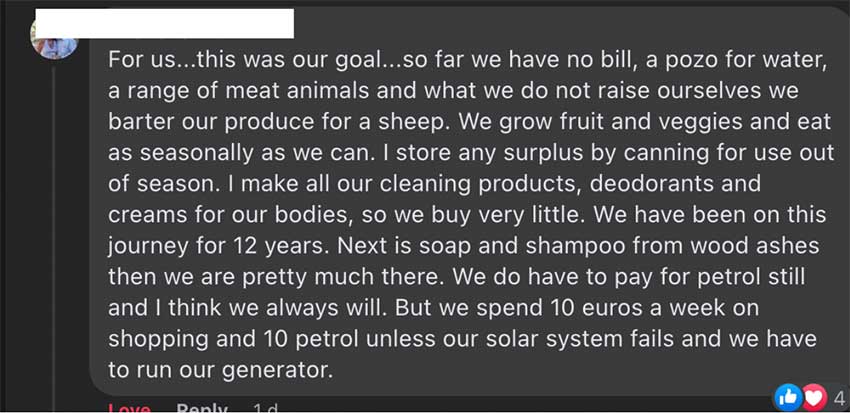

It really comes down to what you need in your life as to how self sufficient you can truly become.
If you can learn to let go of the things you don't really need, your chances of becoming self sufficient will be exponentially greater.
Additional Resources To Help You Become More Self Sufficient
If you'd like to dive deeper into the art of self sufficiency, we've compiled a list of go to resources to get you going:
- My top recommended physical books about self sufficiency
- The self sufficiency USB drive with over 900 books inside
- Instant digital download of the self sufficiency books above
- How to grow your own food
- How to generate your own power
- How to make money from your homestead
- How to be more self sufficient in health