Growing carrots in containers is a quick & easy way to boost your self sufficiency score whether you have a garden or not. This makes it perfect for the suburban homesteader who doesn't have much soil to plant in.

There are a few vegetables that every self sufficient home builder should grow. Carrots are, without doubt, one of those vegetables.
They are readily available in seed packets with thousands of seeds inside for very little cost and they can be grown anywhere, in almost any season.
All it takes is careful planning and successive sowing. With a greenhouse you could even grow carrots all year round.
But even if you don't have a greenhouse (or even a garden) you can grow carrots in containers, tubs, pots, pans or boxes on your balcony if it comes to it.
They are simple to grow, needing only two basic ingredients to flourish:
- Moderate watering
- Deep, loose soil
In this guide, I'm going to teach you how you can start growing carrots in containers today and I promise after you've planted them, you'll feel better tomorrow.
Why Carrots?
As well as being simple to grow in containers, carrots are pretty hardy vegetables too. They store well throughout the year; making them an excellent survival crop.
Mother Earth News has a great article about winter carrots if you want to learn. This makes them an excellent self sufficiency crop.
Thus, if you're looking for an easy vegetable to grow that will bolster your self sufficiency rating quickly by providing you with valuable nutrients throughout the year, growing carrots should be one of your staples.
Start Growing Carrots In Containers Today
There are really only three things you need to start growing carrots today;
- Some deep loose soil
- Some containers deep enough to grow them in
- Some carrot seeds.
Growing carrots in containers is such a self sufficiency hack because you can grow them all year round, without a garden and the height of the container keeps potential pests like carrot fly away.
I'll talk more about that further down the guide. For now though, let's learn how to grow them.
The Key To Growing Carrots In Containers All Year Round
The most important thing you can do when growing carrots in containers for your self sufficient garden is to plan ahead. Have a read of the planning a garden for the apocalypse guide to get some ideas about that.
You need to work backwards from knowing how many carrots you consume each week to be able to create a planting schedule that will provide you with nutrient rich carrots all year round.
For example, we eat about 2kg of carrots per week in our house. That's probably a little bit generous but it's always better to have more than you need.
We simply multiply that number by 52 to give us an annual carrot consumption of 104kg per year.
I typically get 5kg of carrots from every metre long row (that's 3 20 gallon containers in a row).
My smallest raised bed is approximately 50 centimetres wide by 1.2 metres long. If I space my rows 2 inches apart (5cm), I can get 5 rows in my 1.2m x .5m raised bed.
For comparison, you could achieve the same yield in 5 20 gallon containers with carrots sown close together about an inch apart.
My rows provide me with about 25kg of carrots in a single sowing. With well-planned succession planting and clever thinning, I can bump this up to around 50kg per year from this small bed.
Succession planting Is essential for self sufficiency
Succession planting is basically planting one crop after another.
In this case it is planting my early carrots in late summer/early winter first; followed by my main crop carrots in spring and spreading my sowing throughout the season.
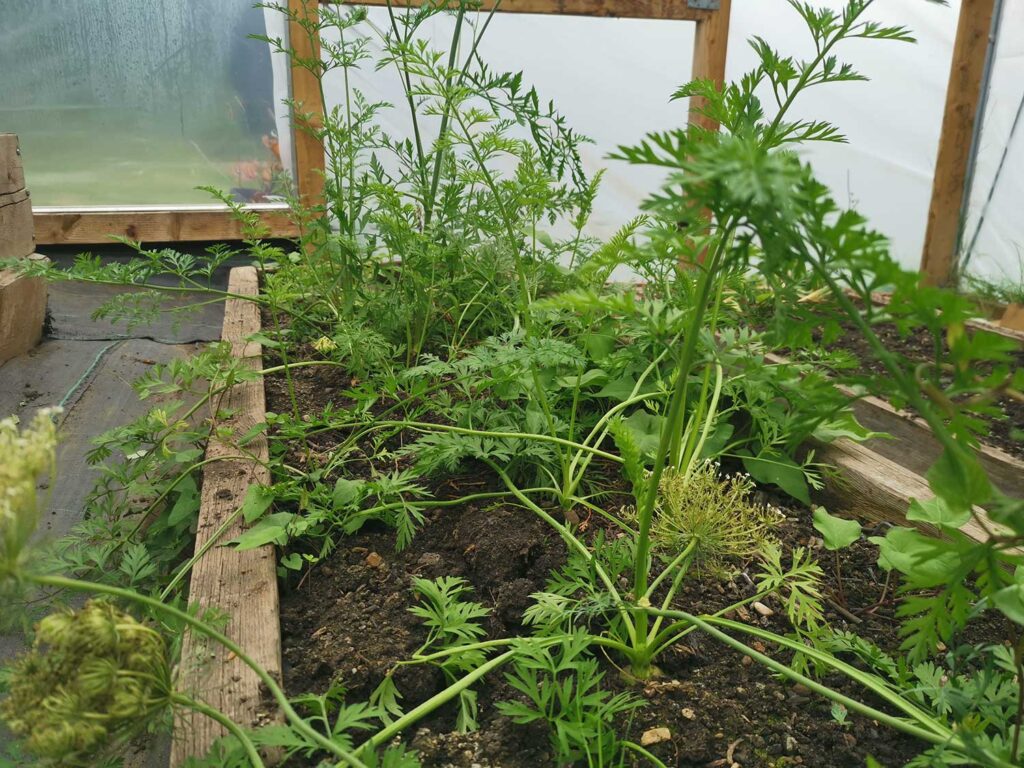
Growing Carrots In Containers for Self Sufficiency
Growing carrots in containers is one of the easiest things you can do to start building your self sufficient food supply. Along with growing potatoes, carrots are one of the first things I make plans to plant every year.
Simply take your packet of seeds and sprinkle liberally in rows along the length of your bed. Don't worry if the seeds are too close together for the moment but make sure your rows are at least 2 inches apart.
Of course, you need to sprinkle your carrot seeds in loose soil preferably in a raised bed or container at least two feet high.
Carrots need loose sandy soil that drains well and is free of contaminants like rocks, twigs and other things that could block the carrot root from growing straight down.
Cover the carrot seeds thinly so that they are no more then one to two centimetres deep.
Water the seeds liberally at this point and cover with dried grass clippings or hay.
How Do You Get Carrots To Germinate Well?
The key to germinating carrots is to never let the soil dry. Keep it damp at all times but not waterlogged.
You could add grass clippings and hay to act as a mulch; which may help suppress the growth of weeds whilst also retaining moisture in the bed or container.
Personally, if you're growing carrots in containers, you probably don't need the mulch but you definitely do need to keep your soil damp.
How long does it take carrots to grow?
Carrot seeds will take about two weeks to germinate (sprout their first two seedling leaves) and about 10 – 16 weeks to grow depending on how big you want them.
Thin Your Carrots For Maximum Yield
When seedlings are about 2 inches tall, you should thin them so they are about 1 inch apart.
This still looks quite crowded but don't worry; you will do one more thinning before you let the main crop grow on.
The beauty of thinning this way is that you will get to eat the small carrots that you thin when the current leaves are about 5 to 6 inches tall.
When leaves are 5 to 6 inches tall you can do a second round of thinning to 2 inches apart and you can eat what you thin.
You can start harvesting the main crop carrots anywhere from 10 to 16 weeks onward.
When you harvest your carrots make sure you are ready to succession plant with the next sowing.
What Pests Attack Carrots In Containers
carrot fly: What Are They
Carrot fly is the most serious pest to carrots. They are small flies that lay eggs at the base of the carrot when the carrot is young. These eggs hatch into tiny maggots that then burrow holes into the root.
Fortunately, there are a few ways to protect your carrots from carrot fly.
- Wise old gardeners recommend planting carrot seeds in containers or beds at least 2 foot high or beneath fine net or cloches.
- Another way, perhaps my favourite way, is to mingle carrot seed with the seed of annual flowers and sow them together. The smell of the flowers masks the smell of the carrots and the carrot fly don't seem to attack as often.
I have had lots of success planting carrots in loose soil in raised beds/containers for years now.
How To Store Carrots To Eat All Year Round

What makes carrots such a good crop to grow for the self sufficient gardener is that they store extremely well in the ground.
I've seen hardy varieties store right throughout the winter and be pulled and eaten in spring.
Whilst this is an efficient way to store carrots until you need them, you may want to harvest them sooner to make space in your bed to grow more food.
If you do this you can store carrots in a cool but well ventilated storage box full of sand. Make sure when you store them that no carrots touch one another.
Finally:
- Do not store carrots that have split roots or are otherwise damaged.
- Do not wash carrots before storing them otherwise they will rot.
- Do not store carrots in the same sand year after year to prevent the accumulation of any disease.
I hope that this simple guide is enough to make you realise that growing carrots in containers is easy, and anyone can do it, wherever they are in the world.
More importantly, I hope this is yet another string in your bow in the battle for food self sufficiency.