Learning how to cook indoors without electricity is a really simple and wholesome method to withdraw your life energy from the ‘grid' and lead a more self sufficient life.
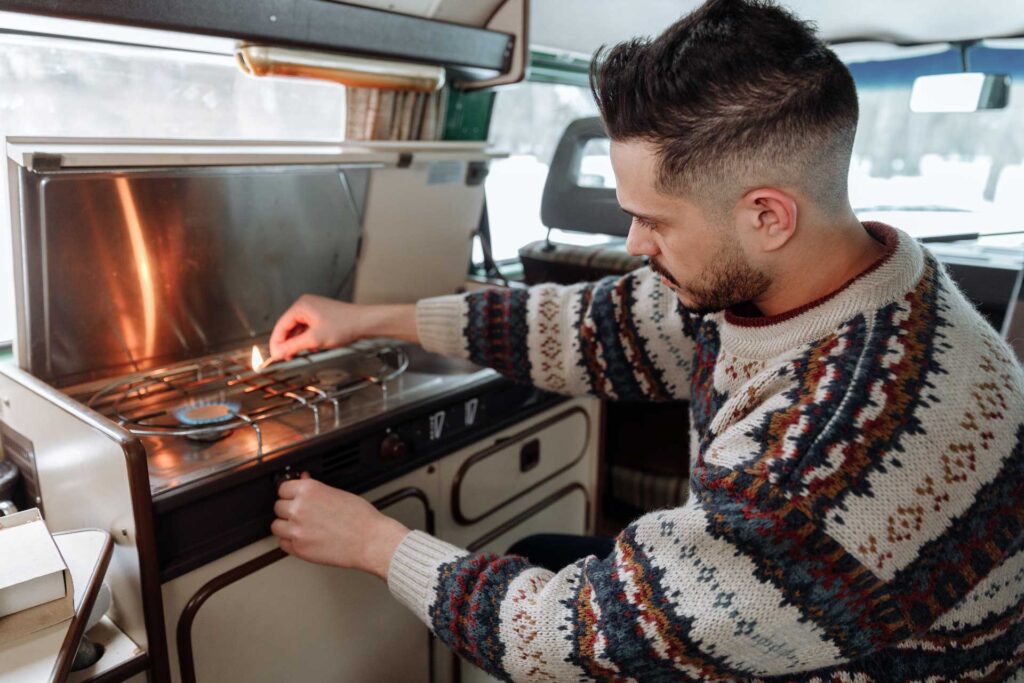
Before you ask me why am I cooking indoors when there's a perfectly good outdoors to cook in, I just want to stress that I'm based in the UK and I don't fancy standing outside cooking on a gas or charcoal barbeque in the dead of winter!
Besides, learning how you can cook indoors without electricity (or being tied to the grid in any way) is one of those self reliance skills you'll be glad to own – even if you never need to use it.
Also paramount to the skill of indoors cooking is how to do it safely.
In this guide, I'll share 5 emergency hacks to cook indoors without electricity safely.
Enjoy!
Safety Precautions Before You Cook Indoors Without Electricity
I don't want to have to repeat this section for every method I share below, so I thought I'd do it just the once here and hammer home a few points about how to safely cook indoors without electricity.
Aside from being the unwelcome love child of government over-reach and the thankless desperation of jobsworths and policy makers to nanny you through life, the main reasons you are told that cooking indoors is not safe are:
- Dangerous & toxic fumes
- Naked flames
- It's probably ‘illegal' somewhere
Here's a quick safety briefing on each before we get to the good stuff.
☠️ Dangerous & Toxic Fumes When Cooking Indoors
The primary reason you get told not to cook indoors is because some fuel, like gas, propane, kerosene, alcohol and wood release Carbon Monoxide (CO). On further investigation, CO is mostly only released when fuel is not completely burned (known as incomplete combustion).
Incomplete combustion takes place when there is not enough oxygen in the vicinity to burn fuel completely.
According to most sources, Carbon Monoxide is poisonous to humans if inhaled.
It's very difficult (for me at least) to find any exact numbers on how much exposure to Carbon Monoxide is poisonous, but I'll share this explanation from the US Consumer Product Safety Commission:
“The health effects of Carbon Monoxide (CO) depend on the CO concentration and length of exposure, as well as each individual's health condition.
CO concentration is measured in parts per million (ppm). Most people will not experience any symptoms from prolonged exposure to CO levels of approximately 1 to 70 ppm but some heart patients might experience an increase in chest pain.
As CO levels increase and remain above 70 ppm, symptoms become more noticeable and can include headache, fatigue and nausea. At sustained CO concentrations above 150 to 200 ppm, disorientation, unconsciousness, and death are possible.“
About as clear as mud to the average person who just wants to cook indoors without electricity, right?
Iowa state university has a much more in-depth table of effects per ppm of CO on humans if you'd like to take a look.
Obviously, and as usual, none of that means anything without context. So let's try and find some.
How Much Carbon Monoxide Does Burning Wood Release?
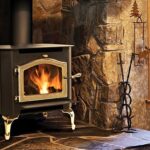
According to the Iowa state university study above, a wood burning stove releases 1-2 ppm if it's burning good quality fuel (dried wood with a moisture content of less than 20%).
Given that CO only becomes dangerous at over 70ppm, there doesn't seem much to worry about here.
I also found two extra studies (1, 2) that both seemed to skirt around the idea of giving a real life, practical example (like burning wood on an open fire in a well ventilated area) and instead, chose to focus on highly concentrated, enclosed areas with very little ventilation.
This leads me to believe that CO emissions are not worth researching when cooking outside or in a well-ventilated area with good and constant airflow – no money to be gained or products to sell? I mean, cavemen burned fires in caves, right?
For some depth though, the second study, Toxic emissions from smouldering combustion of woody biomass and derived char with a case study of CO build-up in an ISO container, concluded:
“In this study, the emissions of CO from wood sawdust and charcoal from the same wood species were evaluated. Sawdust emitted less CO than charcoal. Secondary, a case study of CO accumulation in a confined space was simulated using an ISO container. CO emission from wood sawdust were in the range 98.8 mg/g as lowest to 258.0 mg/g as highest across all temperatures and airflows. On the other hand, the CO emission from charcoal were in the range 98.1 mg/g as lowest to 495 mg/g as highest across all temperatures and 186.6 mg/g as lowest to 426.8 mg/g as highest across all airflows.
There was a general decrease in CO emissions across all temperatures and airflows for both sawdust and charcoal except wood sawdust for which the CO emissions from each sample was affected differently by temperature. The amounts of CO emissions recorded in the ISO container increased with decrease in airflow within the container. Higher amounts of CO were recorded at the upper parts of the container compared to the lower parts.
This study clearly shows that both wood and charcoal produce dangerous amounts of CO which could become even more dangerous in confined spaces in case of aeration challenges.“
Which pretty much leaves me thinking that as long as you have a well ventilated area with free flowing airflow and the fuel you burn burns completely (isn't charcoal), you don't have to worry about CO poisoning.
The one thing that does stick out from the studies though is charcoal.
Charcoal clearly releases more CO than wood and if left to ‘smoulder' in a confined space (like a tent, caravan, room with no windows or ventilation) then you could be putting yourself at risk of dangerous levels of CO poisoning. So don't do that.
Of course, you could always just buy yourself a battery-powered carbon monoxide detector too; just in case, but I honestly don't think it's necessary if you're sensible.
Precautionary Advice For Charcoal
In the same study above, the authors do offer this advice for charcoal which is worth reading at the very least.
“Even when charcoal looks to be out of fire, it is not recommended to take it to any confined space.
The best practice would be to empty the charcoal remaining into a waste/hot charcoal safety bin before storage of the BBQ grill. In the 33 m3 ISO container experiment described above, CO values as high as 70 ppm were recorded from only 270 g of (charcoal+ residual ash) which had remained after the 1 kg charcoal sample was burnt from the outside – this was done to simulate what some CO poisoning victims do after a BBQ meal.
This implies that any confined space smaller than the ISO container used in this study (33 m3) could have registered very high CO concentrations.“
🔥 Naked Flames
The second and much more obvious reason is that flames burn things.
If you're cooking indoors without electricity on a naked flame, you might just set something alight! Heaven forbid the nanny state should let you do that.
But we'll leave that possibility to people who probably shouldn't be cooking anything anyway, let alone using naked flames!
🚫 It's Probably ‘Illegal' Somewhere
Yes, it probably is. Which is another common reason you'll be told not to cook indoors without electricity in an emergency.
I won't go too much into that because if my family are starving or freezing and the only way I can keep them safe is to cook something indoors, I'll not waste a moment thinking about it.
Now, onto the main event.
5 Emergency Hacks To Cook Indoors Without Electricity
Learning to cook indoors without electricity (or access to any utility ‘grid') is one of those skills you can be almost certain you'll be thankful for at some point in the future.
It doesn't require a special skill, not really, but more like a special collection of equipment.
In this guide we'll take a look at some of the best hacks you can use and the equipment you can get your hands on to cook indoors without electricity.
#1. Wood Burning Camping Stoves For Cooking Indoors
Believe it or not, you can use simple wood burning camping stoves to cook a quick hot meal indoors as long as you take heed of the safety warnings above ⚠️.
Firstly, be sure to keep the area well ventilated and aerated with a fresh and continuous supply of oxygen. Open doors and open windows where possible.
Secondly, to cook food safely, wood stoves when used indoors will need a good supply of completely dried and ready to burn wood (with a moisture content less than 20%).
Dried wood burns clean, whereas moist or wet wood won't achieve complete combustion and that's what leads to Carbon Monoxide emissions from wood fuel.
Twigs are easy and free to stock up on and if you collect them whilst you're out walking and leave them to dry properly in a well-made DIY log store you'll have a plentiful supply of free and easy fuel to keep you warm and fed when you need it most.
The big thing with using wood stoves for indoor cooking without electricity is that preparation is key and stocking up on wood now (before you need to cook indoors in an emergency) is the key ingredient.
Here's my two top picks for cooking indoors.
My Top Two Wood Burning Camping Stoves

BioLite CampStove 2+
I can't fail to recommend this fantastic dual-purpose camping stove enough. I plan to do a video review of mine soon.
Not only is it compact at a barely noticeable 935g with total a packed volume of 127mm x 201mm, it also burns exceptionally efficiently.
It will burn [dried] twigs and small bits of wood so efficiently, it will boil 1 litre of water in just 4.5 minutes!
On top of that, it also turns the fire it generates into electricity(!) making it an absolute must-have for a grid-down cooking and charging combo.
If you do nothing else today, go and have a look at this, at the very least.
The BioLite CampStove 2+ is available in the UK and Europe from WildBounds, and the US (and rest of world) from BioLite.

Bushbox XL Titanium
Where other lightweight camping stoves lack the efficiency to produce high temperatures of up to 500c that let you cook proper meals in proper time, the Bushbox XL from German stove manufacturer Bushcraft Essentials doesn't suffer the same fate.
I'm a fan of the Bushbox because the high efficiency multi-fuel burning capability gives you plenty of options if things get rough.
Its highly efficient chimney combined with the ability to pack this away to no thicker than 1cm really does make a superb option if you need to cook inside without electricity in an emergency.
Of course, it is made of titanium and the stove will get extremely hot when in use so the usual precautions should be taken.
Visit Wildbounds to check stock. International shipping available.
#2. Butane Gas Camping Stoves For Indoor Cooking
Like wood stoves, you can use gas camping stoves to cook indoors in an emergency if your electrics go off.
The same rules apply about safety.
Gas camping stoves are compact, burn hot and clean and make excellent indoors cooking stoves.
You can control the temperature better with a gas stove and fuel is readily available – although, admittedly, more expensive than collecting twigs and leaving them to dry.
Any multi-fuel camping stove that runs on either screw top or bayonet gas (to keep your fuel options open) will do the trick but my absolute best pick of them all – one stove to rule them all, is the Trangia 25-2 UL, which I reviewed in the Trangia 25-2 UL review.
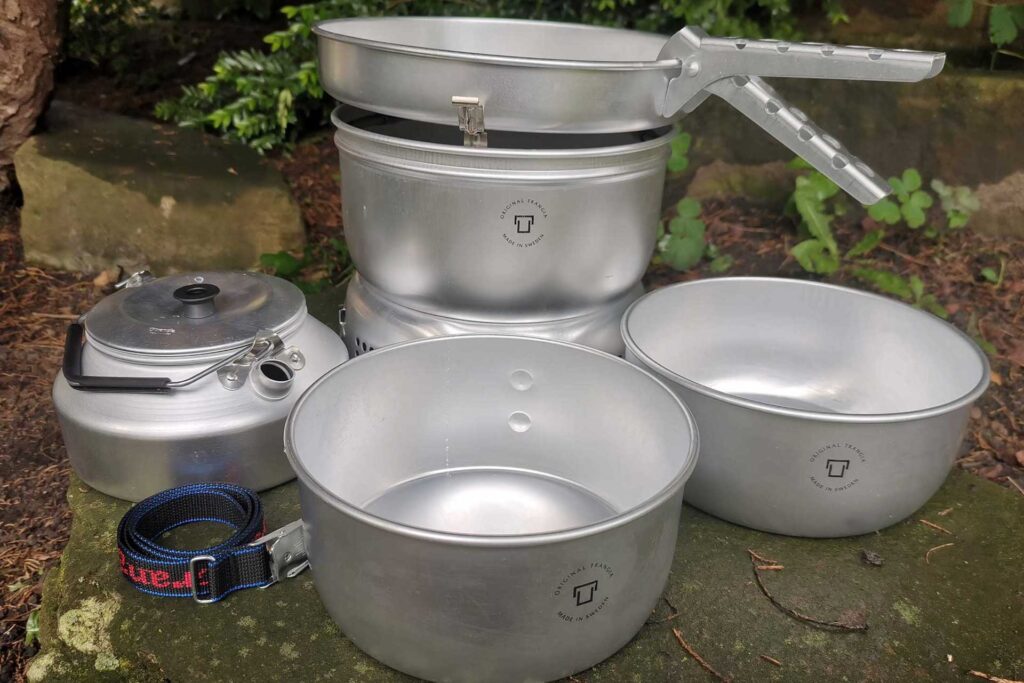
I love this stove because of it's compact nature but also because it burns both gas and alcohol. In a grid-down situation, keeping your fuel options open is an absolute must.
Gas, as you know, burns clean and hot, and carries almost zero risk of carbon monoxide poisoning. In addition, gas stoves, and the Trangia especially, offers a control function, allowing you to adjust the heat on your stove for a better quality cooked meal.
You can buy the Trangia 25-2 UL from Go Outdoors in the UK.
#3. Cook Indoors With An Alcohol Burner Stove

Alcohol stoves are another option for cooking indoors because they burn clean. I wouldn't put them ahead of wood or gas stoves but they scramble an egg or boil some soup in a pickle.
The Trangia 25-2 UL I mentioned in the gas stove section above can also burn alcohol making it an absolute best pick for cooking indoors without electricity.
Alcohol burners are mostly used for walking and hiking owing to their lightweight and compact design.
Another excellent benefit to an alcohol burner is they can burn a number of different fuels – different and readily available alcohols:
- Denatured alcohol
- Yellow HEET
- Isopropyl alcohol
This makes them perfect as an emergency cooking stove for a grid down situation.
All of these fuels burn inside an alcohol burner but denatured alcohol is the best choice because it burns the cleanest.
Alcohol burners are readily available in most outdoors stores and the most popular are the Trangia series of alcohol burners and the Solo Stoves but to be honest, you could probably make your own alcohol burner with a bit of creativity and an aluminium soda can.
You can buy denatured alcohol for fuel readily online.
❕ Don't Forget
Alcohol burners typically don't come with their own grills so make sure you buy one with a grill set to hold your pots and pans (or buy a sperate grill).

#4. Canned Heat: Gel-Fuelled Camping Stove For Clean Indoor Cooking
Often regarded as one of the ‘safest' ways to cook indoors without electricity, canned gel fuel is an excellent option.
It is compact and easy to store, making it pretty easy to stock up and stack up for an emergency.
Canned heat is essentially a can of ethanol gel that will burn clean, hot and odourless. You simply light it with a long match and place your grill over it.
Gel fuel won't give off a lot of heat though so it's not really suitable for grilling steaks but it is more than capable of scrambling some eggs or heating some soup.
As with the alcohol burner above, you'll need a grill to go over the top of this.
The Coughlan's folding gel stove is a good example of how you can use this but you could use any stove with a grill above it in reality.
#5. Tea Light Toaster
My most cheap and cheerful option to help you cook indoors is this tealight toaster.
The tealight toaster is simply a dozen small tealight candles in a roasting tray with a grill over the top.
You could slide this into your oven or grill and leave the door open (with the windows of course) to create a simple cooker that probably won't get hot enough to cook any major meals but would certainly heat up some soup, scramble some eggs or boil some water.
It's amazing what you can do with boiling water so you shouldn't discount it.
And besides, tea lights are always handy to have in stock anyway and you can never really have enough of them.
If you haven't read my guide to make your own tea light heater yet, you might want to have a look at that as an emergency source of heating too.