
Lockdowns gave many a man much to ponder. For me, it was food rationing and shortages, and whether or not I could build my own DIY solar freezer to store more of my homegrown food for longer if the power ever went out.
Disclaimer: I’m a plumber by trade, and a vehicle engineer by profession – I have a fair idea what I’m dealing with, and the calculations that go with it. Electricity and lead acid batteries demand a lot of respect, particularly with sparks and hydrogen gas – if you’re unsure, do seek professional advice.
A Plumber's Journey Towards Self Sufficiency
Where do we start?
In 2018 my wife and I became more and more disenfranchised with town living – certainly with a town in The Chilterns that was expanding exponentially.
We took the decision to move West to be closer to the sea. That’s how we found ourselves at the beginning of 2019 and where our story begins; in a 19th century cottage with a sixth of an acre – about half put to veg, greenhouse, and orchard.
I should say I was no stranger to growing my own food and had been thinking about resilience and self sufficiency for some time before the move.
With the new location, it was my thinking that the veg plot, greenhouse, orchard, and local foraging would yield enough veg to keep us going for about a year in a crisis but we'd probably be short on potatoes and onions towards the end.
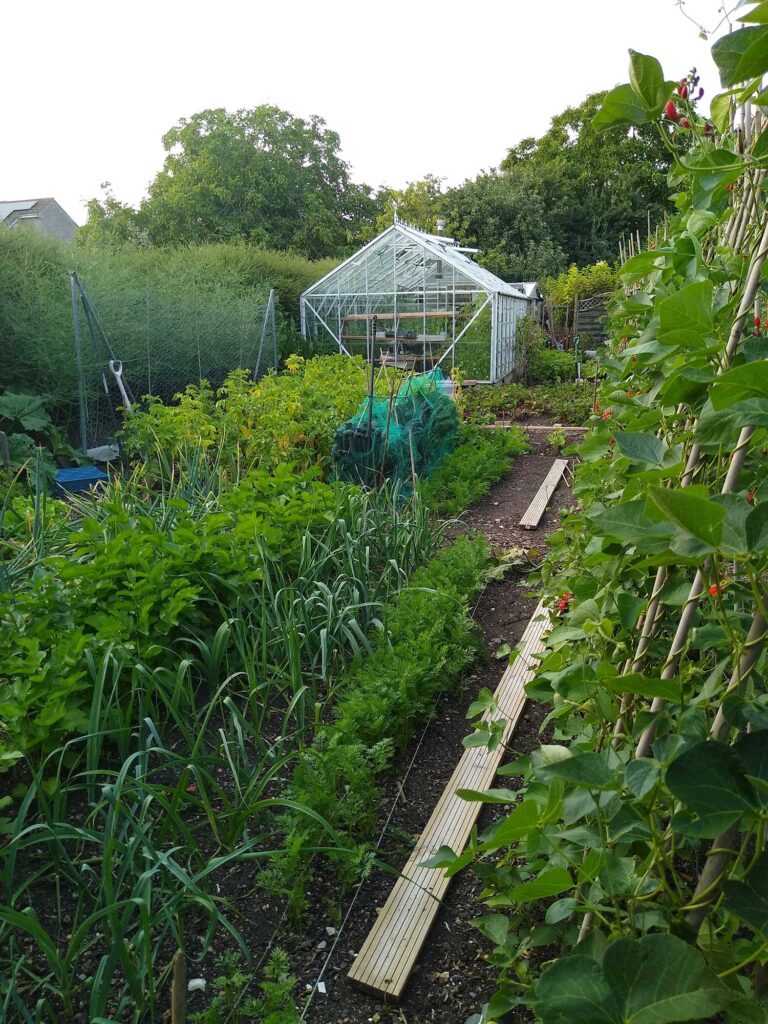
Naturally, growing lots of our own food already, storage was a priority. My wife makes chutneys and jams and root veg is stored in sacks or sand. Dehydrating food is an option too (but not for a solar setup) – running a dehydrator on solar batteries will kill them.
The rest though, is frozen in three backup freezers including surplus fruit (apples/foraged plums).
As circumstance would have it, being a plumber and a specialist in pumps, I got called to a job a couple of villages over – the guy has since become a friend. He lives completely off grid with his own borehole water and 8kw of solar panels in his diy solar generator. That got me thinking about how I could generate my own power.
Could I build my own small DIY solar freezer setup to keep my freezers running if the power ever dropped?
I pondered it for a time and researched as much as I could about how I would go about it and just as I felt confident enough to get started, an opportunity arose.
Building A DIY Solar Freezer Backup To Store My Homegrown Produce
Not long after the first lockdown in 2020 (and shortages of various foods) storing of homegrown food – and more importantly resilience – pushed its way to the front of my mind; what would happen if the power went off?
I can cook and heat with a wood burner, there’s water in a stream at the end of the road – but the potential to lose a season’s worth of veg was bothering me.
It was about that time that the guy who is now a friend was making noises about upgrading his off grid solar setup – and he asked me if I wanted to buy his old kit.
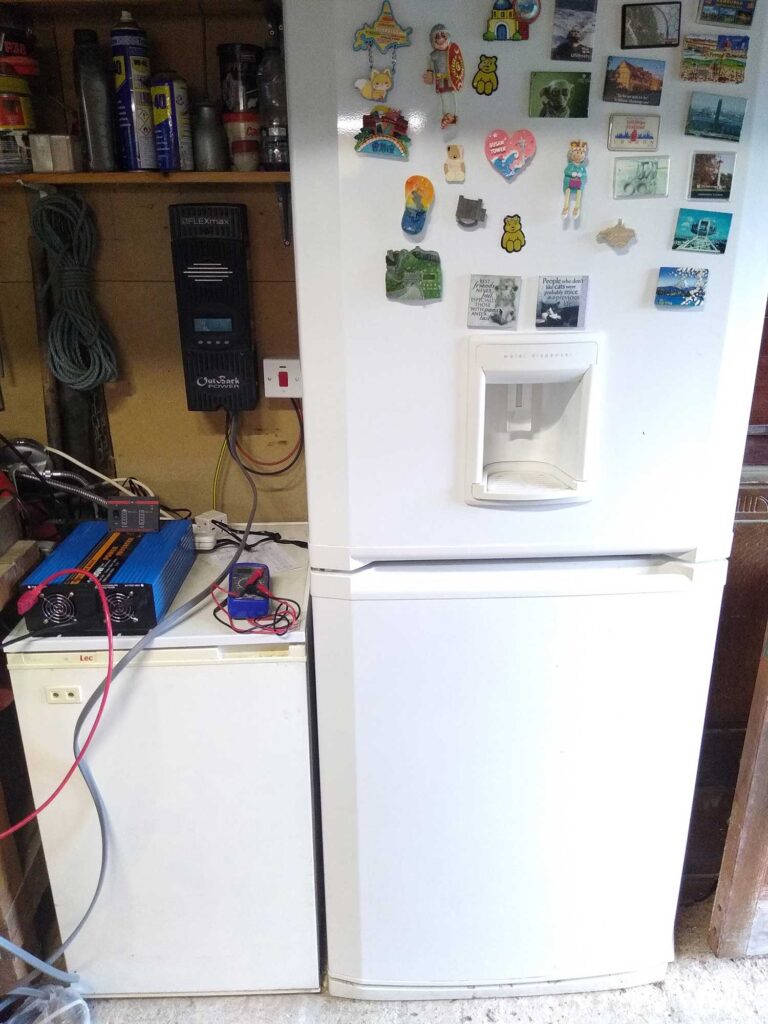
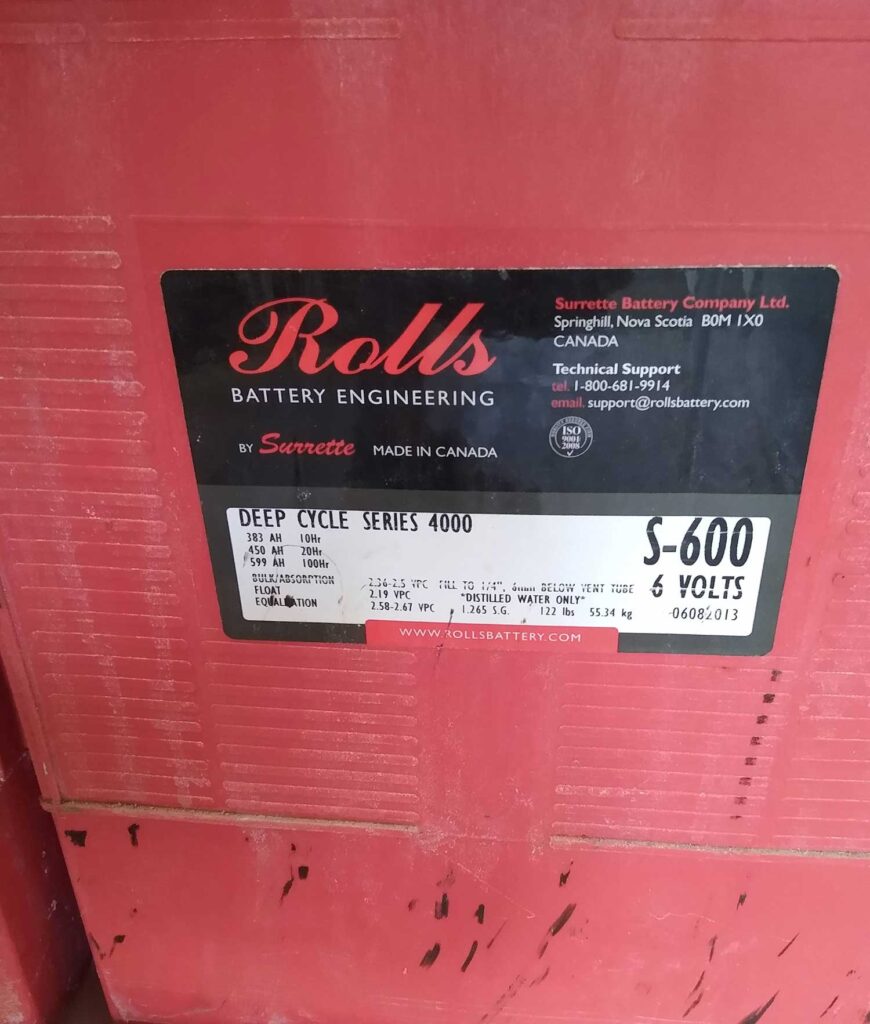
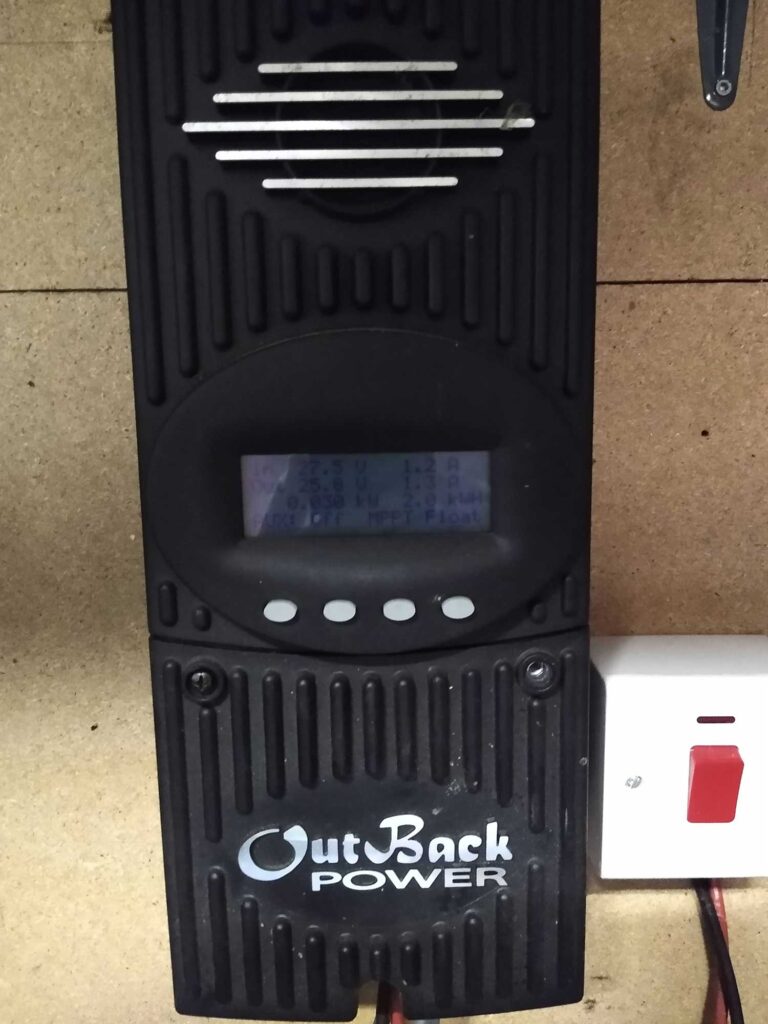
It was a solid-state charge controller supplying Rolls deep cycle lead acid batteries. All I’d need to supply would be the appropriate number of solar panels and an inverter (I’ll list the technical stuff at the bottom).
I accepted his offer and we duly – being in Somerset and all – arranged a mutually beneficial deal; I finish off a kitchen for his parents, he lets me have the charge controller and 4 batteries. Net £650. 👍
Calculating The Power Requirement
Sounds good. But where do we go from here, then?
I needed to know just how much power my freezers consumed, so I bought a cheap energy meter online. You basically plug the meter into your socket and the appliance into the meter, setting the correct setting before you do.
This showed me the freezers ran at around 300 watts when they were operating, with a potential few seconds burst of up to 1000 watts to get the compressors going.
If you want to run your own solar calculations before you commit, the calculator over at Bimble Solar will help.
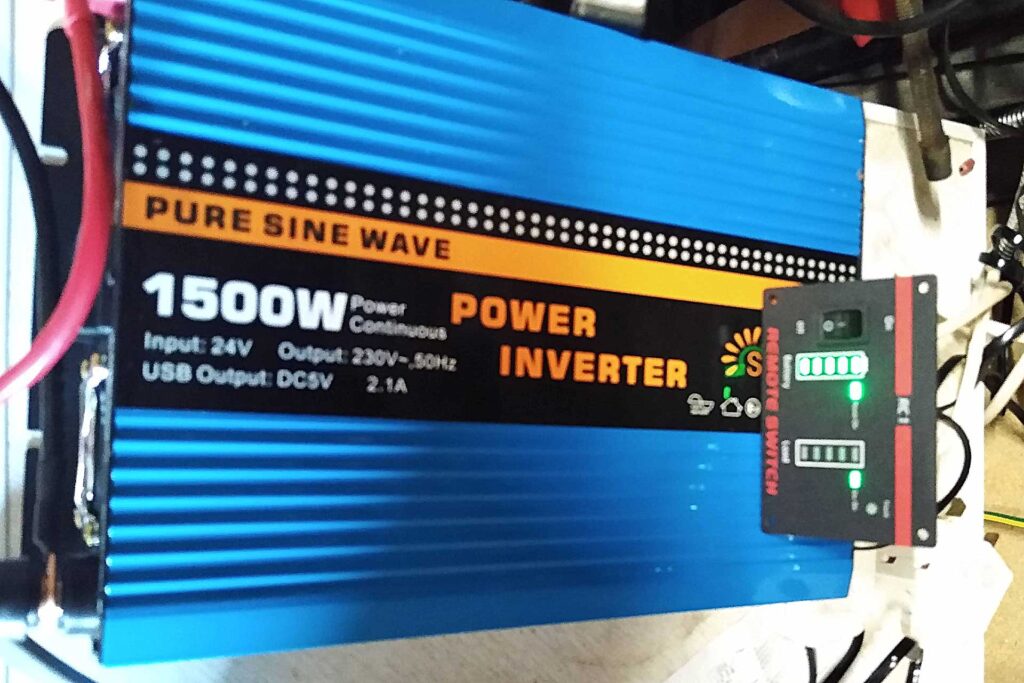
Solar Inverter
This gave me my figure for my inverter; however, I wanted some extra capacity so I went for 1500 watts with a short burst capability of 3000 watts. Inverter cost: £200.
Unfortunately, it’s a Chinese make, but high quality kit doesn’t come cheap.
Batteries For Storing Solar Energy
The batteries I bartered are 6v deep cycle rated at 450ah (amp hours) linked in series to give me a 24v system (this saves on cable size). In other words, they will give a given current for a given number of hours; for example 1 amp for 450 hours, or 450 amps for an hour – or any multiple in between.
This is slightly misleading though as lead acid batteries shouldn’t be drained by more than 50% (225ah).
Solar Panels
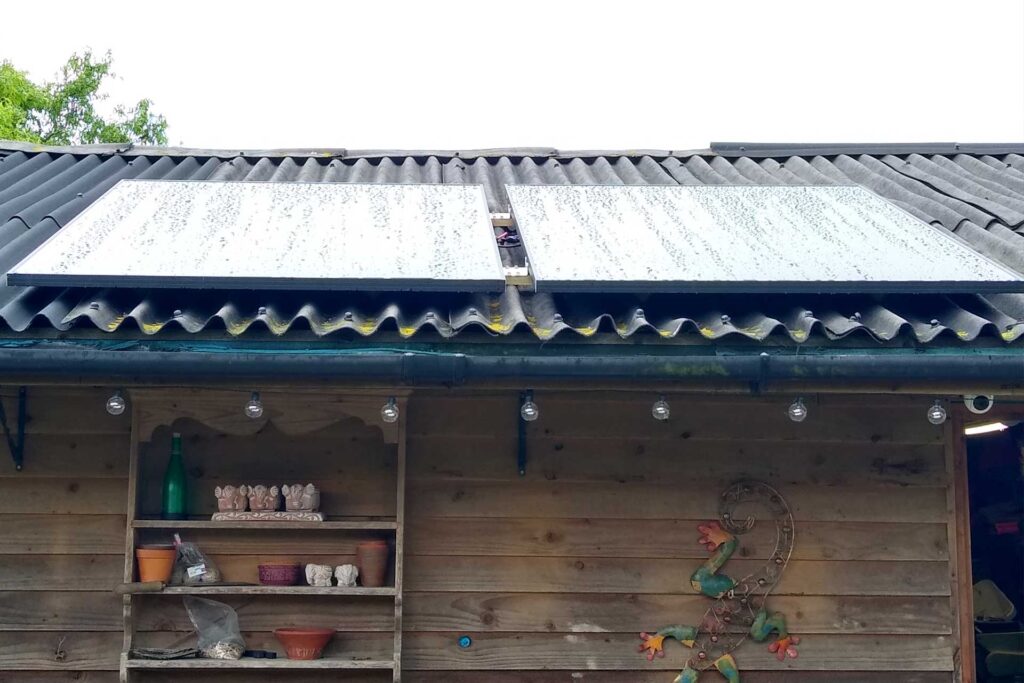
I bought 2 new solar panels from an online retailer at 420 watts each – cost around £500 with mounts, cable joints and cable extensions.
That gives me 840 watts of solar power maximum. I made the roof mounts from timber I generally have kicking round my workshop.
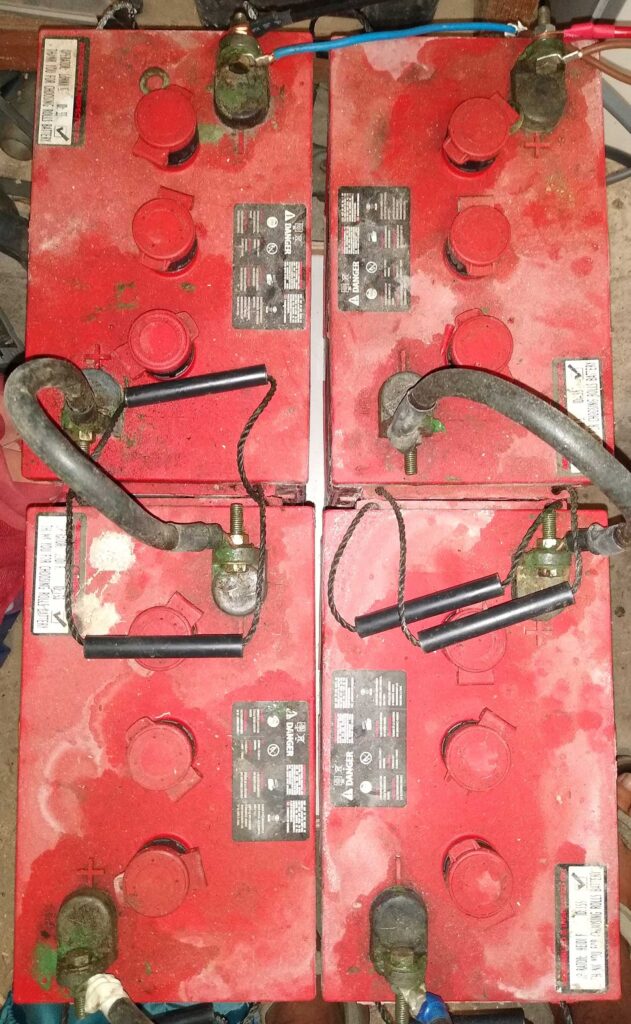
DIY Solar Freezer Power Requirements
I have 840w going into 225ah batteries at 30v.
To give the watt hour capacity of the batteries – this is as simple as multiplying the two (225ah x 24 = 6750 watt hours).
We know the freezers use 300 watts each, so this setup would keep the freezers running for 22 hours if they ran all the time.
Realistically they use around 1200 watts over 24 hours, so even without extra solar input the batteries will run the freezers for over 5 days. But don’t forget, in my diy solar freezer setup I have 840w available when the sun shines.
Even on a dull day they will still generate 200 watts constantly.
At the time of writing (in the July 2022 ‘heatwave'), I’ve saved myself 2kwh today, or about 56p. Multiplied over the year that gives me a simplistic saving of £200 – so I’m looking at about a 6 year payback; less when energy prices inevitably rise.
It's important to note that whilst the financial return is good, this project is not so much about the financial payback as it is about the food security.
Risks of Winter: What The Future Holds
I will be frank and say I’ll be sailing right on the edge in winter. The batteries need to run the freezers overnight and then be recharged the next day by the panels.
At the same time, the panels are running the freezers; that’s my risk analysis acceptance in the worst case scenario of the main grid going dark, but I do have a small petrol generator as a backup backup.
Glossary of Terms
- Solar panels:
Pretty much self descriptive. They come in various voltages, watts, efficiency, etc. It’s a minefield, I went for mid price, high power, high efficiency. - Deep cycle batteries:
Unlike a car battery that has to provide a short burst of energy, deep cycle batteries are designed to provide a steady supply of energy over a long time. Their life cycle is finite (around 8 years) before they start to lose capacity. Lithium is a better alternative than lead acid in that they can be drained completely – but they are horribly expensive at the time of writing. - Charge controller:
A device that takes you varying power and voltage from the solar panels, and changes it to a smooth output to ensure the batteries are kept in the best condition possible. - Inverter:
Changes (Direct Current (DC)) battery voltage to mains voltage (Alternating Current (AC))
This has been a complete learning curve for me. I may not have some parts right – but its good enough for what I want and need.
I hope it helps you get started creating your own DIY solar freezer setup and if you'd like to ask any questions, please feel free to get in touch at the details below or by joining me over in the online community.







Very informative, thank you.
I live in the tropics and have done similar but I don’t believe I have sufficient panels to be completely off grid.
Also it’s our winter here now and we have dull days.
May I ask what charge controller you’re using? I had a BMV but it “blew up” so I’ve installed a timer for now.
I’m using an Outback Flexmax 80 – I could double my panels and it’ll still cope. Am I reading that right – you have no charge controller going into your batteries? I’d be concerned about boiling them – a 12v solar panel outputs 18v, my 24v panels run at just over 31v at full power.
Thank you Colin, that is brilliant. Same issue has crossed my mind as the second freezer needs replacing but am considering possible power cuts and food ruined so would it be worth the cost? With your skills it would be a no brainer but am now considering learning how to can foods instead.
Far more work involved though!
I think I’ll eventually replace at least one of the freezers as it’s old and does draw a lot of power. Canning/dehydration is another good option – anything as long as you have access to food it everything goes wrong in society.